


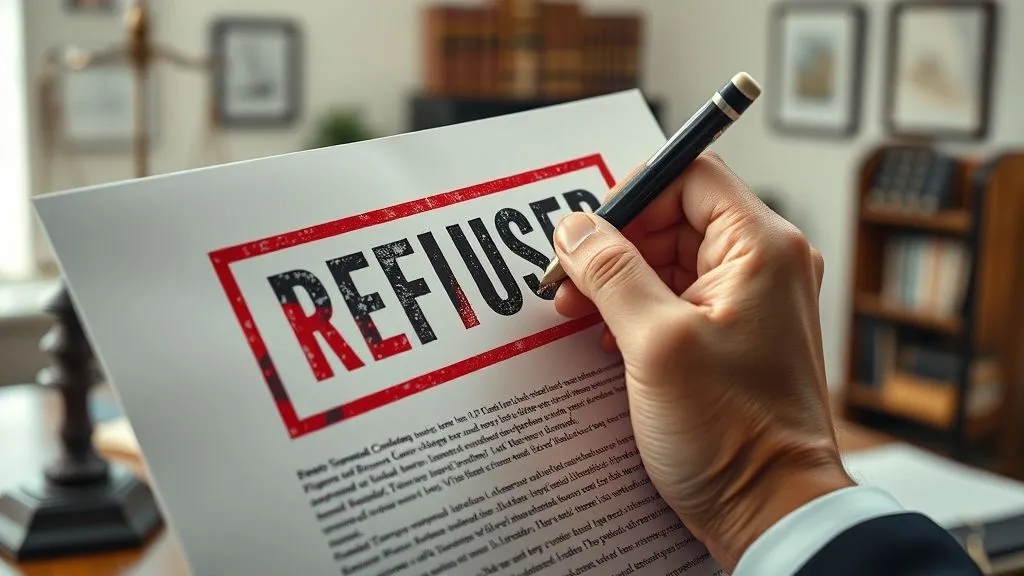
How to Challenge a Trademark Refusal and Protect My Brand Name?
For over 15 years in intellectual property law, I’ve witnessed the crushing disappointment when a meticulously crafted brand name, the very identity of a business, receives that dreaded “Office Action” – a formal refusal from the trademark office. It’s a moment of panic, often feeling like a complete roadblock after months of planning and investment.
Many entrepreneurs, faced with this bureaucratic hurdle, mistakenly believe it’s the end of the road. They either abandon their chosen name or, worse, proceed without protection, leaving their brand vulnerable. This common pitfall can lead to devastating consequences down the line, from costly rebrands to losing market share to opportunistic competitors.
But here’s the truth: a trademark refusal is rarely a final “no.” It’s an invitation to engage, to present your case, and to defend your brand’s rightful place in the market. In this definitive guide, I’ll walk you through the precise, actionable steps on how to challenge a trademark refusal and protect your brand name, leveraging expert insights and strategic frameworks I’ve refined over years of practice.
Understanding the “Office Action”: What Went Wrong?
Before you can effectively challenge a trademark refusal, you must first thoroughly understand the examiner’s rationale. An Office Action isn’t just a rejection; it’s a detailed explanation of why your application failed to meet the statutory requirements. Ignoring or misinterpreting these reasons is a critical mistake.
Common Grounds for Refusal
In my experience, trademark refusals typically fall into a few categories, each requiring a tailored response strategy. The most frequent issues include:
- Likelihood of Confusion (Section 2(d)): This is by far the most common reason. The examiner believes your mark is too similar to an existing registered mark, and that consumers would likely be confused about the source of goods or services. They weigh factors like similarity of the marks (sound, sight, meaning) and similarity of the goods/services.
- Descriptiveness or Genericness (Section 2(e)(1)): Your mark might be deemed merely descriptive if it immediately conveys an ingredient, quality, characteristic, function, purpose, or use of your goods or services. If it’s generic, it refers to the common name of the goods or services themselves, making it unregistrable.
- Geographically Descriptive or Misdescriptive (Section 2(e)(2) & (3)): If your mark primarily indicates a geographical origin of the goods/services, or falsely suggests a connection to a geographical location.
- Primarily a Surname (Section 2(e)(4)): If your mark’s primary significance to the public is that of a surname.
- Lack of Distinctiveness: Sometimes, a mark is simply too common or weak to function as a source identifier without further evidence.
Expert Insight: A comprehensive pre-application trademark search is your first and best defense against many of these refusals. It helps identify potential conflicts before you invest heavily in a name. I’ve seen countless clients save significant time and money by conducting thorough searches upfront.

The Critical First Step: Assessing Your Office Action
Once you receive an Office Action, resist the urge to panic or react emotionally. The clock starts ticking immediately, as you typically have six months to respond. This period is not just for drafting a reply; it’s for strategic analysis.
Deciphering the Examiner’s Rationale
Carefully read the entire Office Action, paying close attention to the specific sections of the Trademark Act cited and the examiner’s detailed explanations. The examiner will usually provide examples of conflicting marks or evidence supporting their descriptiveness claim.
Here’s what to focus on during your initial assessment:
- The Specific Statute Cited: This tells you the legal basis for the refusal (e.g., Section 2(d) for likelihood of confusion).
- The Cited Mark(s) (if applicable): Analyze the cited mark(s) – their appearance, sound, meaning, and the goods/services they cover.
- The Examiner’s Evidence: What dictionary definitions, news articles, or other evidence did the examiner use to support their claims of descriptiveness or genericness?
- Your Application’s Goods/Services: How broadly or narrowly are your goods/services defined? Is there room for amendment?
Expert Insight: Never assume the examiner has made an error without first understanding their full argument. While examiners are generally thorough, they sometimes miss nuances that you, as the applicant, are in a better position to clarify.
Crafting Your Response: Arguments and Evidence
This is where the real work begins: formulating a persuasive legal argument supported by evidence. Your goal is to convince the examiner that their initial assessment was incorrect or that your mark, despite their concerns, is indeed registrable. This is the heart of how to challenge a trademark refusal and protect your brand name.
Likelihood of Confusion Refusals: Building Your Case
When facing a 2(d) refusal, your strategy revolves around distinguishing your mark from the cited mark. The USPTO (United States Patent and Trademark Office) uses the “du Pont factors” to assess likelihood of confusion. You need to argue that, based on these factors, confusion is unlikely. Here’s how:
- Differences in the Marks: Highlight any distinctions in appearance, sound, or meaning between your mark and the cited mark. Even subtle differences can be significant when combined with other factors.
- Differences in Goods/Services: Argue that your goods or services are sufficiently different from those of the cited mark, even if the marks themselves bear some resemblance. Provide details on specific uses, target consumers, and marketing channels.
- Differences in Trade Channels and Classes of Consumers: If your products are sold in different retail environments or target different, sophisticated consumer bases, this can reduce the likelihood of confusion.
- Absence of Actual Confusion: While difficult to prove early on, if your mark has been in use for some time without any reported instances of actual confusion, this can be a persuasive point.
- Third-Party Registrations: If you can find other similar marks registered for similar goods/services by different entities, it can demonstrate the weakness of the cited mark or the distinctiveness of a particular element.
Descriptiveness/Genericness Refusals: Proving Distinctiveness
For 2(e)(1) refusals, you need to prove that your mark is not merely descriptive or, if it is, that it has acquired “secondary meaning” – meaning consumers now associate the descriptive term with your specific brand. This is known as acquired distinctiveness.
- Arguing Non-Descriptiveness: Explain why your mark, in the context of your goods/services, is not merely descriptive. Perhaps it’s suggestive (requiring imagination to connect to the goods), arbitrary (a common word used in an uncommon way), or fanciful (a coined word).
- Evidence of Acquired Distinctiveness (Secondary Meaning): If your mark is indeed descriptive, you’ll need to submit evidence that it has become distinctive through extensive use. This can include:
- Length and exclusivity of use (typically at least five years of substantially exclusive and continuous use).
- Advertising expenditures and promotional efforts.
- Sales volume and market share.
- Consumer surveys demonstrating association with your brand.
- Unsolicited media coverage or testimonials.
Expert Insight: The burden of proof shifts to you when responding to these refusals. You must present compelling evidence, not just assertions. The quality and quantity of your evidence are paramount.
| Refusal Type | Key Argument Strategy | Evidence Type |
|---|---|---|
| Likelihood of Confusion (2(d)) | Distinguish marks and/or goods/services | Market analysis, consumer behavior, industry practice, third-party uses |
| Descriptiveness/Genericness (2(e)(1)) | Prove non-descriptiveness or acquired distinctiveness | Advertising spend, sales data, duration of use, consumer surveys, media coverage |
Amending Your Application: A Strategic Pivot
Sometimes, the best way to challenge a trademark refusal isn’t a direct confrontation, but a strategic amendment to your application. This can often resolve issues that seem insurmountable through argument alone.
Narrowing Goods/Services
If your application includes a broad list of goods or services, and the conflict arises only with a subset, you might be able to narrow your application to exclude the problematic items. This can be particularly effective in likelihood of confusion cases where the cited mark covers only a specific niche.
Adding a Disclaimer
If your mark contains a descriptive or generic component that cannot be removed, you might be able to “disclaim” the right to that specific component apart from the mark as a whole. This means you’re not claiming exclusive rights to the descriptive part, but only to your unique combination of elements.
Switching to the Supplemental Register
For marks that are merely descriptive but have the potential to acquire distinctiveness over time, applying for the Supplemental Register can be a viable option. While it doesn’t offer the same immediate protections as the Principal Register, it provides notice to others and allows you to build evidence for eventual Principal Register status once secondary meaning is established.
Expert Insight: Amendments should be carefully considered to ensure they don’t undermine your brand strategy or future expansion plans. A slight adjustment now can prevent significant headaches later.
The Power of Negotiation: Examiner Interviews and Consents
Trademark law, like many legal fields, isn’t always about rigid rules; there’s often room for negotiation and collaboration. Engaging directly with the examiner or seeking consent from the owner of a cited mark can be powerful tools in your arsenal.
Engaging with the Trademark Examiner
A personal interview with the examining attorney can often clarify misunderstandings, explore potential amendments, or even lead to a resolution that wasn’t apparent from the written record. I’ve found that a professional, respectful dialogue can sometimes bridge the gap between the examiner’s perspective and your own. It allows for a more fluid discussion of arguments and potential solutions.
Letters of Consent and Coexistence Agreements
In likelihood of confusion cases, if the owner of the cited mark is amenable, they can provide a “Letter of Consent,” stating they don’t believe confusion is likely and consent to your registration. These letters are highly persuasive, especially if backed by a “Coexistence Agreement” that formally outlines how both parties will use their marks without causing confusion. This often involves defining specific fields of use, geographic areas, or marketing channels. This is a crucial strategy on how to challenge a trademark refusal and protect your brand name when facing a 2(d) refusal. For more details on these agreements, the USPTO provides guidance on their effectiveness: USPTO TMEP Section 1207.01(VIII)(B).
Expert Insight: While a Letter of Consent is powerful, it’s not a guaranteed solution. The examiner still has the ultimate say, and the consent must be well-reasoned and not appear to be a mere “naked consent” without a clear basis for no likelihood of confusion.
When to Appeal: The Trademark Trial and Appeal Board (TTAB)
If all efforts to persuade the examining attorney fail, and you firmly believe your mark is registrable, your next step is to appeal to the Trademark Trial and Appeal Board (TTAB). This is a more formal, quasi-judicial process.
Understanding the TTAB Process
An appeal to the TTAB begins with filing a Notice of Appeal and paying the requisite fee. You then submit an appeal brief, which is a comprehensive legal document outlining your arguments and citing relevant case law and evidence. The examining attorney will also submit a brief defending their refusal. Sometimes, an oral hearing is requested, allowing both sides to present their arguments to a panel of administrative trademark judges.
Preparing Your Appeal Brief
Your appeal brief is critical. It must:
- Clearly state the issues on appeal.
- Present a detailed argument for registrability, citing legal precedent.
- Reference all relevant evidence submitted during the examination process.
- Be well-organized, concise, and persuasive.
Case Study: How “AquaFlow Innovations” Overcame a Descriptiveness Refusal
AquaFlow Innovations, a startup specializing in advanced water filtration systems, faced a refusal for “AQUAFLOW” on grounds of descriptiveness. The examiner argued that “Aqua” (water) and “Flow” (movement) directly described their products. Instead of abandoning the name, I advised them to gather extensive evidence of acquired distinctiveness. They had been using the mark for six years, invested significantly in advertising, and had a substantial market presence. We compiled five years of advertising budgets, sales figures, customer testimonials, and media mentions. During the appeal, we presented a compelling brief demonstrating that “AQUAFLOW” had, through consistent and prominent use, developed a secondary meaning – consumers now associated it specifically with AquaFlow Innovations’ unique technology, not just the generic concept of water flowing. The TTAB ultimately reversed the refusal, allowing AquaFlow Innovations to register their mark and protect their brand name, securing their investment and market position.
Expert Insight: Appealing to the TTAB is a serious legal proceeding. It requires a deep understanding of trademark law and appellate procedure. It’s almost always advisable to have experienced counsel guide you through this stage. For more information on TTAB proceedings, visit the official USPTO TTAB page.
Beyond the USPTO: Protecting Your Brand Globally
While challenging a USPTO refusal is critical for your domestic rights, remember that brand protection is often a global endeavor. Your strategy shouldn’t end with a successful registration in one country.
International Trademark Strategy
If your business operates or plans to operate internationally, you’ll need to consider filing for trademark protection in other jurisdictions. The Madrid Protocol offers a streamlined way to apply for trademark registration in multiple member countries through a single application. However, each country will still conduct its own examination, and you might face similar refusal challenges abroad. Understanding these processes is key to a holistic brand protection strategy. The World Intellectual Property Organization (WIPO) offers extensive resources on international filings: WIPO Madrid System.
Monitoring and Enforcement
Registration is just the beginning. Ongoing vigilance is crucial to protect your brand name. You must actively monitor for infringing uses of your mark and be prepared to enforce your rights. This includes:
- Trademark Watch Services: These services monitor new applications and uses of similar marks.
- Cease and Desist Letters: Issuing formal warnings to infringers.
- Litigation: Pursuing legal action if necessary to stop infringement.
Expert Insight: A registered trademark is a powerful asset, but it’s only as strong as your willingness to defend it. Proactive monitoring and enforcement are vital for maintaining the integrity and value of your brand.

Expert Guidance: The Indispensable Role of a Trademark Attorney
While I’ve outlined the steps on how to challenge a trademark refusal and protect your brand name, it’s important to acknowledge the complexity of trademark law. Navigating Office Actions, drafting legal arguments, and appealing to the TTAB are highly specialized tasks. This is where the value of an experienced trademark attorney becomes indispensable.
Why You Need Specialized Counsel
A qualified trademark attorney brings:
- In-depth Legal Knowledge: They understand the nuances of trademark law, relevant case precedents, and USPTO examination guidelines.
- Strategic Insight: They can assess the strengths and weaknesses of your case, identify the most effective arguments, and advise on the best course of action – whether to argue, amend, or appeal.
- Drafting Expertise: Crafting a persuasive and legally sound response requires precise language and attention to detail.
- Negotiation Skills: They can effectively communicate with examiners and negotiate with owners of cited marks.
- Procedural Familiarity: They know the deadlines, forms, and procedures for responding to Office Actions and appealing to the TTAB, ensuring no critical steps are missed.
According to industry reports, applicants represented by counsel have a significantly higher success rate in overcoming Office Actions than those who proceed pro se. The complexity of trademark prosecution makes this a wise investment for your brand’s future.

Expert Insight: While attorney fees are an investment, consider them a protective measure for your brand – often far less costly than a rebrand, lost market share, or a full-blown infringement lawsuit down the line.
Frequently Asked Questions (FAQ)
What if my mark is refused after appeal to the TTAB? If the TTAB affirms the refusal, you still have options. You can appeal their decision to the U.S. Court of Appeals for the Federal Circuit or file a civil action in a U.S. district court. These are advanced and costly legal proceedings, making a strong case at the TTAB level even more critical. In some cases, it might be more strategic to consider a new mark or a significant modification to your existing mark.
Can I re-file my trademark application after a refusal? Yes, you can re-file, but it’s generally not advisable without addressing the issues that led to the initial refusal. Simply re-filing the same application will likely lead to the same refusal. It’s crucial to understand the examiner’s reasoning and make substantive changes to your mark or goods/services, or to submit new evidence, before re-filing.
How long does the trademark appeal process take? The timeline can vary significantly. Responding to an Office Action typically has a six-month deadline. If you appeal to the TTAB, the entire process, from filing the Notice of Appeal to receiving a decision, can take anywhere from 12 to 24 months, or even longer, depending on the complexity of the case and the TTAB’s caseload.
What’s the typical cost of challenging a trademark refusal? The cost can range widely. Responding to a simple Office Action might involve a few hours of an attorney’s time. However, if the refusal leads to a complex argument, extensive evidence gathering, or an appeal to the TTAB, costs can quickly escalate into several thousands of dollars or more. This includes attorney fees, official USPTO fees for appeals, and potential costs for consumer surveys or expert testimony if needed.
Is it possible to challenge an existing trademark that is blocking my application? Yes, it is possible. If you believe the cited mark that is blocking your application was improperly registered (e.g., it’s generic, descriptive without acquired distinctiveness, or abandoned), you can initiate a cancellation proceeding at the TTAB against that registered mark. This is a complex adversarial proceeding and should only be undertaken with expert legal counsel.
Key Takeaways and Final Thoughts
Receiving a trademark refusal is a challenge, but it is by no means a death knell for your brand. With the right strategy, understanding, and expert guidance, you can effectively challenge a trademark refusal and protect your brand name. Here are the critical takeaways:
- Understand the “Why”: Thoroughly analyze the Office Action to grasp the examiner’s specific reasons for refusal.
- Craft a Strong Response: Develop well-reasoned legal arguments supported by compelling evidence, whether distinguishing your mark or proving distinctiveness.
- Consider Strategic Amendments: Don’t shy away from narrowing goods/services or adding disclaimers if it helps overcome the refusal.
- Leverage Negotiation: Engage professionally with the examiner and explore consent agreements where appropriate.
- Be Prepared to Appeal: If necessary, understand the TTAB process and prepare a robust appeal brief.
- Seek Expert Counsel: The complexity of trademark law makes a skilled trademark attorney an invaluable asset.
Your brand is a cornerstone of your business, representing your reputation, values, and promise to your customers. Don’t let a procedural hurdle deter you from securing its legal protection. Embrace the challenge, equip yourself with knowledge, and take proactive steps to safeguard your intellectual property. Your brand’s future depends on it.
Recommended Reading
- Unlocking Your Rights: The Crucial Time Limits for Maritime Cargo Claims
- 5 Legal Strategies: Businesses vs. Government Internet Censorship Orders
- Can Schools Punish Off-Campus Speech? 5 Legal Limits Explained
- Land Use Variance: What's Allowed and How to Get Approved?
- 5 Global Tax Hacks: Structure International Profits, Minimize Burden





Comments
Leave a comment below. Your email will not be published. Required fields marked with *