



How to Legally Challenge a State Constitutional Amendment's Validity?
For over two decades in the trenches of constitutional law, I've witnessed firsthand the profound impact—both positive and negative—that state constitutional amendments can have on citizens' lives. I've also seen the frustration, and sometimes despair, when an amendment is perceived as unjust, improperly passed, or even unconstitutional. It's a daunting prospect to stand against what often feels like an immovable force, a decision codified by the will of the people or their representatives.
The problem isn't just the sheer difficulty; it's the labyrinthine legal pathways, the stringent procedural requirements, and the often-misunderstood distinction between what's politically unpopular and what is genuinely legally invalid. Many believe that once an amendment is ratified, it's set in stone, beyond reproach. This perception, while understandable, overlooks the critical role of judicial review in safeguarding the foundational principles of our federal and state constitutions.
In this definitive guide, I'll draw upon my extensive experience to demystify the process. You'll learn not just *if* you can challenge a state constitutional amendment's validity, but *how* – from establishing standing and identifying specific legal grounds to navigating the complex litigation landscape in both state and federal courts. We'll explore actionable frameworks, examine crucial case studies, and equip you with the expert insights needed to approach such a challenge with confidence and a clear strategy.
Understanding the Foundation: What Makes an Amendment Valid?
Before you can effectively challenge a state constitutional amendment's validity, you must first understand the bedrock principles that define its legitimacy. An amendment isn't valid simply because it passed; it must conform to both procedural and substantive legal requirements. In my experience, many challenges falter because they don't clearly distinguish between these two critical dimensions.
Procedural Requirements: The Path to Enactment
The first line of defense often lies in scrutinizing the process by which an amendment was proposed and ratified. Each state's constitution meticulously outlines the steps required for an amendment to become law, and any deviation can render it invalid. These processes vary significantly:
- Legislative Proposal: Most common, where a state legislature proposes an amendment, often requiring a supermajority vote in both houses, followed by voter ratification.
- Ballot Initiative: In some states, citizens can propose amendments directly through petitions, which then go to a popular vote.
- Constitutional Convention: Less frequent, where a convention is called to propose amendments or even draft an entirely new constitution, subject to voter approval.
Crucial procedural elements include proper notice to the public, accurate ballot language, adherence to single-subject rules (where one amendment addresses only one issue), and precise voting majorities. I've seen countless cases where a seemingly minor procedural misstep became the Achilles' heel of an otherwise popular amendment.
Substantive Limits: Federal Supremacy & State Constitutions
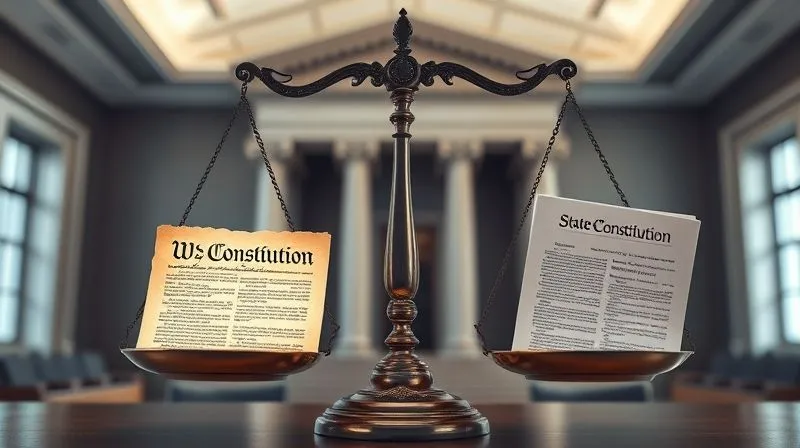
Even if an amendment sails through all procedural hurdles, its substance must still pass constitutional muster. This involves two layers of review: consistency with the U.S. Constitution and consistency with other provisions of the state's own constitution. The U.S. Constitution, particularly the Supremacy Clause (Article VI, Clause 2), establishes that federal law and the U.S. Constitution are the supreme law of the land.
This means a state constitutional amendment cannot:
- Violate fundamental rights guaranteed by the U.S. Constitution (e.g., freedom of speech, due process, equal protection under the 14th Amendment).
- Contradict federal statutes or treaties that are within Congress's constitutional authority.
Furthermore, a state amendment might also be challenged for violating other, pre-existing provisions of the *state's own constitution* or principles that are deeply embedded within its legal framework. While less common, this internal inconsistency can also be a powerful ground for challenge.
Establishing Standing: Who Can Challenge an Amendment?
A critical initial hurdle in any lawsuit, especially one of such magnitude, is establishing legal 'standing.' This isn't just a technicality; it's a fundamental principle ensuring that courts only hear genuine controversies brought by parties with a direct stake in the outcome. In my practice, I've had to explain countless times that simply disagreeing with an amendment, no matter how strongly, isn't enough to get through the courthouse doors.
To challenge a state constitutional amendment's validity, you must demonstrate a concrete, particularized injury that is directly caused by the amendment and that can be redressed by a favorable court decision. Without this, your case will be dismissed before it even reaches the merits.
Generally, standing can be established in several ways:
- Direct Harm: The most common basis. You must show that the amendment directly harms you in a personal, tangible way. For example, if an amendment changes property rights, a property owner directly affected would likely have standing.
- Taxpayer Standing: In some jurisdictions, taxpayers can challenge governmental expenditures or actions that they believe violate constitutional provisions, arguing that it improperly uses their tax dollars. This is often narrowly construed.
- Organizational Standing: An organization can sue on behalf of its members if its members would otherwise have standing to sue in their own right, the interests at stake are germane to the organization's purpose, and neither the claim asserted nor the relief requested requires the participation of individual members in the lawsuit.
Proving standing requires careful legal analysis and often a detailed factual presentation. It's not enough to allege a generalized grievance shared by the public. You must differentiate your injury. This is where a seasoned constitutional lawyer can help you identify and articulate that specific harm.

Identifying Grounds for Challenge: Procedural Defects
As I mentioned, the 'how' an amendment was passed is often as important as the 'what' it says. Procedural defects are a fertile ground for challenging a state constitutional amendment's validity, as they directly undermine the democratic legitimacy of the amendment's enactment. My experience tells me that these arguments, while sometimes technical, can be incredibly powerful.
Defective Ballot Language or Misleading Summaries
Voters rely on ballot language and summaries to understand what they are voting on. If these are intentionally or negligently misleading, confusing, or omit crucial information, the entire vote can be tainted. Courts often require ballot language to be neutral, transparent, and accurately reflect the amendment's content and potential effects. A challenge here might argue that voters were deprived of their right to make an informed decision.
Violation of Single-Subject Rule
Many state constitutions include a 'single-subject rule' for amendments, meaning an amendment must address only one topic or purpose. This prevents 'logrolling,' where unpopular provisions are bundled with popular ones to ensure passage, and helps voters understand the specific changes being proposed. If an amendment attempts to address multiple disparate issues, it may be vulnerable to challenge. For example, an amendment that simultaneously alters election law and environmental regulations would likely violate such a rule.
Improper Notice or Publication
Constitutions often prescribe specific methods and timelines for publicizing proposed amendments before a vote. This ensures public awareness and opportunity for debate. If these notice requirements (e.g., publication in specific newspapers for a certain duration) are not strictly followed, it can be a procedural defect. Similarly, if the text of the proposed amendment was not made publicly available in the prescribed manner, a challenge could arise.
Exceeding Legislative Authority in Proposal
Legislatures proposing amendments must act within the powers granted to them by the state constitution. If a legislature attempts to propose an amendment that falls outside its constitutional authority or usurps powers reserved for a constitutional convention or the people directly, that amendment could be challenged. This is a more complex argument, often involving deep dives into the historical context and intent of the state's constitutional framers.
Case Study: How a Single-Subject Rule Invalidated an Amendment
Consider the fictional state of 'Veridia,' which passed a constitutional amendment via legislative proposal. The amendment, titled 'The Public Safety and Economic Prosperity Act,' included provisions to establish a statewide gun registry, increase sales tax by 1%, and create a new state park system. While popular individually, the combination was seen as an attempt to leverage public support for parks to pass controversial tax and gun control measures.
A citizens' group, 'Veridia for Fair Governance,' successfully challenged the amendment, arguing it violated Veridia's strict single-subject rule. The state supreme court agreed, finding that three distinct and unrelated subjects were bundled into one proposal, thereby preventing voters from expressing their will on each issue independently. The amendment was struck down, forcing the legislature to propose each measure separately, if at all. This case perfectly illustrates how challenging a state constitutional amendment's validity on procedural grounds can be highly effective.
Identifying Grounds for Challenge: Substantive Defects
Beyond procedural missteps, a state constitutional amendment can be challenged on substantive grounds—meaning what the amendment *does* or *says* violates higher legal principles. This is often where the most significant constitutional battles are waged, as it delves into the core rights and structures of our governance. As a constitutional lawyer, these are the arguments that resonate most deeply with the spirit of the law.
Violation of the U.S. Constitution (Supremacy Clause)
This is arguably the most potent substantive challenge. The U.S. Constitution is the supreme law of the land, and no state, through its constitution or laws, can contravene its provisions. Common targets for such challenges include:
- First Amendment Rights: Amendments that restrict free speech, freedom of religion, or the right to assemble may be challenged.
- Fourteenth Amendment Rights: This amendment's Equal Protection Clause (prohibiting states from denying equal protection of the laws) and Due Process Clause (guaranteeing fair treatment and fundamental rights) are frequent battlegrounds. For example, an amendment that discriminates against a protected class or denies a fundamental liberty without due process would be vulnerable.
- Contract Clause (Article I, Section 10): While primarily aimed at state laws, some state constitutional amendments could be challenged if they substantially impair existing contractual obligations without a legitimate public purpose.
When you seek to legally challenge a state constitutional amendment's validity based on federal supremacy, you are essentially arguing that the state has overstepped its bounds within the federal system.
Violation of Fundamental Rights Protected by the State Constitution
Even if an amendment doesn't violate the U.S. Constitution, it might still infringe upon rights or principles explicitly or implicitly guaranteed by the *state's own constitution*. State constitutions can, and often do, provide broader protections for individual rights than the federal Constitution. For instance, a state constitution might explicitly protect environmental rights or educational equality in ways the federal document does not. An amendment that undermines these existing state-level protections could be challenged internally.
Impairment of Contracts or Ex Post Facto Laws
While less common for modern constitutional amendments, these are still valid grounds. An ex post facto law (or amendment) retroactively criminalizes an act that was legal when committed or increases the penalty for a crime after it was committed. An amendment that retroactively impairs contractual obligations, without a compelling public interest, could also face a challenge under the contract clauses of both the U.S. and state constitutions.
The delicate balance between state sovereignty and federal constitutional limits is the cornerstone of our federal system. Substantive challenges require a deep understanding of constitutional jurisprudence and a careful application of precedent.
The Litigation Pathway: State vs. Federal Courts
Once you've identified grounds and established standing, the next critical decision is *where* to file your challenge. This choice—state court versus federal court—is strategic and depends heavily on the specific nature of your claims. My advice always emphasizes understanding the nuances of each jurisdiction.
Starting in State Court: Trial to Supreme Court
Most challenges to state constitutional amendments begin in state trial courts. This is particularly true if your challenge primarily relies on state law grounds, such as procedural defects in the amendment's passage or violations of other provisions within the state's constitution. State courts are the primary interpreters of their own state's constitution and laws.
The typical path would involve:
- Trial Court: Filing a complaint, engaging in discovery, and potentially a bench trial (heard by a judge without a jury) to determine facts and initial legal rulings.
- Intermediate Appellate Court: If you lose at the trial level, you'd appeal to the state's intermediate appellate court.
- State Supreme Court: The highest court in the state, which has the final say on matters of state law. A favorable ruling here means the amendment is invalidated within that state.
Even if your case involves federal constitutional questions, state courts have concurrent jurisdiction to hear those claims. However, if you lose on federal grounds in the state supreme court, you may still have an avenue to appeal to the U.S. Supreme Court.
Federal Court Avenues: When Federal Questions Arise
If your primary challenge is that the state constitutional amendment violates the U.S. Constitution, you may have the option to file directly in federal court. This is known as 'federal question jurisdiction.' Federal courts are often seen as more insulated from state political pressures, which can be an advantage in highly charged constitutional cases.
The federal pathway involves:
- U.S. District Court: The federal trial court.
- U.S. Court of Appeals: If you lose at the District Court, you appeal to the circuit court of appeals.
- U.S. Supreme Court: The final arbiter of federal law. Reaching this court is rare and requires a grant of 'certiorari.'
It's important to note the doctrine of 'abstention,' where federal courts may decline to hear a case and instead send it to state courts if state law issues are unresolved or if there's a strong state interest involved. Choosing the right forum is a complex decision that requires careful strategic planning with experienced counsel.
| Consideration | State Court Advantages | Federal Court Advantages |
|---|---|---|
| Primary Legal Grounds | Expertise in state constitutional law, final arbiter of state law | Expertise in federal constitutional law, potentially less state political influence |
| Judges' Appointment | Often elected (can be pro or con) | Life tenure (insulated from politics) |
| Pace of Litigation | Can vary widely by state | Generally more uniform and often faster |
| Appellate Path | State Supreme Court final on state law, then US Supreme Court on federal questions | US Supreme Court final on federal questions |
Crafting Your Legal Strategy: Key Elements for Success
A constitutional challenge is not merely about identifying a legal flaw; it's about meticulously building a compelling case that persuades a court. From my years of experience, I've learned that a strong legal strategy involves careful preparation, robust argumentation, and sometimes, strategic coalition building. This is where the art of advocacy truly comes into play when you aim to legally challenge a state constitutional amendment's validity.
Building a Strong Factual Record
Constitutional cases often hinge on facts. For procedural challenges, this means gathering evidence of how the amendment was proposed, publicized, and voted upon. This might include ballot summaries, legislative journals, public notices, and election results. For substantive challenges, it could involve demonstrating the real-world impact of the amendment on individuals or groups, often requiring expert testimony or statistical data.
Actionable Steps for Factual Record:
- Document Collection: Systematically gather all official documents related to the amendment's passage.
- Expert Affidavits: Secure statements from experts (e.g., political scientists, economists, demographers) to illustrate the amendment's impact or procedural flaws.
- Witness Testimony: Identify and prepare witnesses who can speak to the direct harm caused or to specific procedural irregularities.
Selecting the Right Legal Arguments
You may have multiple potential grounds for challenging an amendment. A crucial part of the strategy is to prioritize and focus on the strongest, most likely-to-succeed arguments. Sometimes, a procedural argument is cleaner and less politically charged than a substantive one. Other times, the substantive violation is so clear that it becomes the primary focus. My guidance here is always to pick your battles wisely.
Amicus Curiae Briefs and Coalition Building
Constitutional challenges often involve broad public interest. Engaging other organizations, academics, or even former government officials to file 'amicus curiae' (friend of the court) briefs can significantly bolster your case. These briefs provide additional legal analysis, empirical data, or policy arguments that support your position, demonstrating to the court that the issue has widespread concern and implications beyond your immediate parties.
Building a coalition of diverse stakeholders can also provide financial support, public awareness, and a unified voice, increasing the political and legal pressure for a favorable outcome.

Navigating the Appellate Process and Potential Outcomes
Challenging a state constitutional amendment is rarely a quick process; it often involves multiple levels of appeal, demanding persistence and a long-term view. Understanding the appellate landscape is crucial for managing expectations and sustaining your legal effort.
Appeals to Higher State Courts
As discussed, if your initial challenge in a state trial court is unsuccessful, you will typically proceed through the state's appellate system. This involves filing notices of appeal, preparing detailed briefs arguing legal errors made by the lower court, and often presenting oral arguments before panels of appellate judges. The state supreme court's decision on state law issues is final.
The Path to the U.S. Supreme Court (Certiorari)
If your challenge involves a substantial federal constitutional question and you have exhausted all state court avenues (meaning the highest state court has ruled on your federal claim), you may petition the U.S. Supreme Court for a writ of certiorari. This is an extraordinary remedy; the Supreme Court grants very few of these petitions each year, typically only for cases that present novel or conflicting federal constitutional issues of national importance. It's a long shot, but it is the ultimate avenue for federal constitutional claims.
Success in challenging a state constitutional amendment requires not just legal acumen, but immense perseverance. The legal system is designed to uphold the law, but also to respect the will of the people, so the bar for overturning an amendment is purposefully high.
Potential Outcomes
- Amendment Invalidated: The best-case scenario, where the court declares the amendment unconstitutional or improperly enacted, rendering it null and void. This is a powerful victory.
- Amendment Upheld: The court finds no legal defect, and the amendment remains in effect. This doesn't mean the amendment is necessarily good policy, just that it passed legal muster.
- Partial Invalidation or Severability: Sometimes, only certain provisions of an amendment are found unconstitutional, while the rest remains in force, especially if a 'severability clause' is present, indicating that valid parts should stand even if others fall.
- Remand: The appellate court might send the case back to a lower court for further proceedings, perhaps to gather more facts or apply a different legal standard.
Legal Precedent and Emerging Trends in Constitutional Challenges
The field of constitutional law is dynamic, constantly evolving with new judicial interpretations and societal changes. Keeping abreast of legal precedent and emerging trends is crucial for anyone looking to legally challenge a state constitutional amendment's validity. What might have been an unassailable amendment decades ago could be vulnerable today, given shifts in legal thought or new societal understandings.
For example, the application of the Equal Protection Clause has seen significant evolution, particularly concerning LGBTQ+ rights and voting rights. Similarly, challenges related to environmental protections or digital privacy, while perhaps not traditionally constitutional issues, are increasingly being framed within constitutional rights frameworks as states grapple with modern challenges.
I always advise my clients to look beyond just the immediate case law of their state. National trends in constitutional interpretation by the U.S. Supreme Court and other federal courts can often provide persuasive authority, even in state court challenges. For instance, a recent trend I've observed is increased scrutiny on ballot initiative processes, particularly regarding transparency and voter information, reflecting a growing concern over potential manipulation of the democratic process.
According to a study published in the Harvard Law Review, challenges to state constitutional amendments have become more frequent and sophisticated over the past decade, often leveraging a combination of federal and state constitutional arguments to maximize their chances of success. This underscores the importance of a comprehensive and multi-faceted legal strategy.
Staying informed about these developments, through legal journals, academic papers, and professional seminars, is not merely academic; it's a strategic imperative. It allows for the anticipation of counter-arguments and the formulation of innovative legal theories to push the boundaries of existing law.
Frequently Asked Questions (FAQ)
Question: Can a federal court directly overturn a state constitutional amendment? Yes, but only if the state constitutional amendment violates the U.S. Constitution or federal law. Federal courts do not have the authority to overturn a state constitutional amendment based solely on state law grounds or perceived unfairness. They can only intervene if there's a clear violation of federal constitutional rights or federal statutes that are supreme to state law.
Question: What's the role of the state Attorney General in these challenges? The state Attorney General's office typically defends the validity of state constitutional amendments when they are challenged in court. They represent the state and its interests, arguing that the amendment was properly enacted and is consistent with both state and federal law. Their involvement is almost guaranteed in such high-stakes litigation.
Question: How long does a constitutional challenge typically take? A constitutional challenge to a state amendment is rarely swift. From initial filing in a trial court to a final decision by a state supreme court or even the U.S. Supreme Court, the process can easily take several years, often ranging from 2-5 years or even longer, depending on the complexity of the issues, the court's docket, and the number of appeals.
Question: Is it possible to challenge an amendment *before* it's ratified? Generally, no. Courts are hesitant to rule on hypothetical or speculative harms. A challenge usually requires the amendment to be officially enacted or at least to be on the ballot and causing imminent, concrete harm. Pre-enforcement challenges are rare and require a very specific set of circumstances to establish ripeness and standing.
Question: What are the costs involved in such a challenge? Challenging a state constitutional amendment is an exceptionally complex and resource-intensive undertaking. Legal fees alone can easily run into hundreds of thousands or even millions of dollars, given the extensive research, expert testimony, discovery, motion practice, and multiple appellate stages. Many such challenges are brought by well-funded organizations or through pro bono efforts.
Key Takeaways and Final Thoughts
Challenging a state constitutional amendment's validity is, without a doubt, one of the most demanding and significant areas of legal advocacy. It requires not just a profound understanding of constitutional law, but also strategic foresight, meticulous preparation, and unwavering perseverance. As an experienced industry specialist, I've seen the monumental effort these cases demand, but also the profound impact a successful challenge can have on safeguarding constitutional principles and individual rights.
- Understand the Dual Layers of Validity: An amendment must satisfy both procedural enactment rules and substantive constitutional limits (state and federal).
- Establish Clear Standing: You must demonstrate a direct, concrete injury caused by the amendment.
- Identify Specific Grounds: Focus on precise procedural defects (e.g., ballot language, single-subject rule) or substantive violations (e.g., U.S. Constitution, state bill of rights).
- Choose Your Forum Wisely: Strategically decide between state and federal courts based on the nature of your claims.
- Build a Robust Case: A strong factual record, focused legal arguments, and coalition building are paramount.
- Prepare for a Long Haul: Constitutional challenges are multi-stage processes often involving extensive appeals.
While the path is arduous, remember that judicial review is a cornerstone of our democracy, ensuring that even the will of the majority or its representatives operates within the bounds of constitutional law. If you believe a state constitutional amendment is fundamentally flawed, seeking expert legal counsel is your first, most crucial step. The fight for constitutional integrity is a vital one, and with the right strategy and dedication, it is a fight that can be won. For further reading on the intricacies of constitutional litigation, I recommend exploring resources from the American Bar Association's Constitutional Law section or Cornell Law School's Legal Information Institute.
Recommended Reading
- FBI Seizes Records? 7 Critical Steps Your Company MUST Take NOW
- Exposed! The Ultimate Guide to Reporting Deceptive Marketing Practices
- Ultimate Guide: How to Enforce IP Rights Against Online Piracy Effectively
- 7 Expert Strategies: Reduce Regulatory Risk from Inter-Branch Disputes
- Client Hiding Accident Medical History? 7 Steps for Attorneys





Comments
Leave a comment below. Your email will not be published. Required fields marked with *