


How to Prove Miranda Rights Violation Despite Ambiguous Client Waiver?
For over three decades in constitutional law, I've witnessed the profound and often devastating impact of police interrogations on individuals, particularly when their fundamental Fifth Amendment rights are at stake. It’s a delicate dance between law enforcement’s need for information and an individual’s right against self-incrimination. I’ve seen countless cases where a client’s understanding of their Miranda rights, or their subsequent waiver of those rights, was anything but clear, leading to confessions that should never have been admitted.
The core problem arises when a client's waiver of their Miranda rights appears ambiguous. Police often push for a waiver, and in the high-stress environment of an interrogation, individuals, often unrepresented and emotionally vulnerable, may utter words or perform actions that law enforcement later interprets as a clear waiver. Yet, to a seasoned legal eye, these actions or statements are riddled with doubt, hesitation, or a fundamental misunderstanding. This ambiguity creates a formidable challenge for the defense: how do you prove a violation when the 'waiver' isn't explicitly clear but also not explicitly revoked?
This article is designed to be your definitive guide in navigating these treacherous waters. Drawing from my extensive experience, I will provide you with actionable frameworks, delve into critical legal precedents, and offer expert insights into deconstructing ambiguous waivers. We will explore the evidentiary tools at your disposal, from meticulous analysis of interrogation recordings to the strategic use of expert testimony, empowering you to effectively challenge questionable waivers and protect your client's constitutional rights.
Understanding the Miranda Warning and Waiver Fundamentals
Before we can prove a violation, we must first firmly grasp the bedrock principles of Miranda. The Supreme Court in Miranda v. Arizona established that before custodial interrogation, suspects must be informed of their right to remain silent, that anything they say can and will be used against them, their right to an attorney, and that if they cannot afford an attorney, one will be appointed for them. This is not merely a formality; it's a constitutional imperative designed to combat the inherent coerciveness of police interrogations.
The "Knowing and Intelligent" Standard
For a waiver of Miranda rights to be valid, the prosecution bears the heavy burden of proving, by a preponderance of the evidence, that the waiver was both knowing and intelligent. This means the suspect must have understood the rights they were giving up and the consequences of doing so. It's not about legal sophistication, but about basic comprehension. Did they understand they didn't have to talk? Did they grasp that their words could be used against them? In my experience, this is where ambiguity often creeps in, especially with individuals who have limited education, mental health issues, or language barriers.
The "Voluntary" Standard
Beyond being knowing and intelligent, the waiver must also be voluntary. This means it must be "the product of a free and deliberate choice rather than intimidation, coercion, or deception." The waiver cannot be extracted through threats, promises, or psychological manipulation. This standard requires examining the totality of the circumstances surrounding the interrogation, a concept we will revisit. A waiver given under duress, even if seemingly understood, is invalid.
"The burden is on the prosecution to prove, by a preponderance of the evidence, that the waiver was both knowing, intelligent, and voluntary. If there's a crack of doubt, that's your opening."
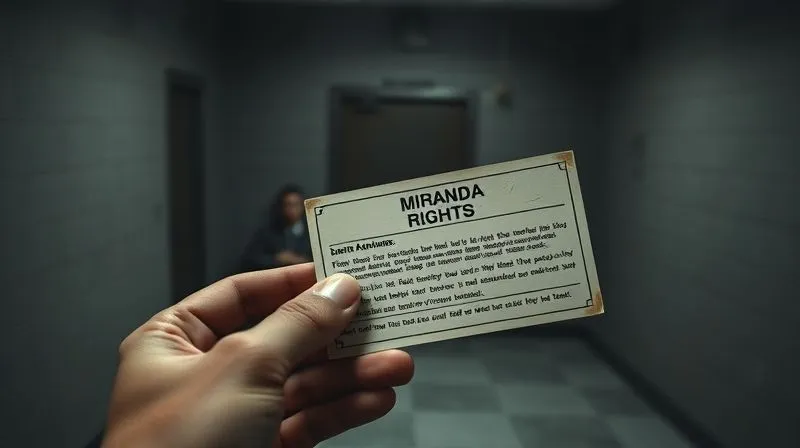
Police often carry a 'Miranda card' or read from a form. However, simply reading the rights and obtaining an initial nod or 'yes' doesn't automatically satisfy these high standards, particularly when ambiguity arises later. It's the context, the suspect's demeanor, and the officers' subsequent actions that often reveal the true nature of a purported waiver.
Deconstructing Ambiguity: What Constitutes an Unclear Waiver?
Ambiguity is the enemy of a valid Miranda waiver. It's not always a direct 'I don't understand' or 'I want a lawyer.' Often, it's far more subtle, a series of hesitations, equivocal statements, or non-verbal cues that, taken together, paint a picture of confusion rather than clear consent. Identifying these nuances is paramount for a successful challenge.
Verbal vs. Written Waivers
While a written waiver often seems more definitive, even a signed form can be ambiguous if the surrounding circumstances suggest a lack of understanding or voluntariness. Verbal waivers are inherently more susceptible to ambiguity. A client might say, "I guess I'll talk," or "Maybe I should get a lawyer, but I'll tell you what happened." These are not clear affirmations of waiver and should be vigorously challenged. The U.S. Supreme Court, in North Carolina v. Butler, noted that while an explicit statement of waiver is not invariably necessary, silence alone is not enough to establish a waiver.
Equivocal Statements and Hesitation
This is fertile ground for proving a Miranda violation. An equivocal statement is one that is unclear or susceptible to multiple interpretations. Examples include: "Do I need a lawyer?" "I don't know if I should say anything." "I'm not sure I understand this." These are not clear assertions of rights, but they are also not clear waivers. Police are generally required to cease interrogation or clarify the suspect's intent when faced with such statements, especially regarding the right to counsel. Their failure to do so can be a critical point of contention.
- Listen for Qualifiers: Words like "maybe," "I guess," "I think," "sort of."
- Identify Questions Posed by Suspect: Especially those about rights or legal counsel.
- Note Pauses and Silences: Prolonged hesitation before answering or signing can indicate confusion or reluctance.
- Observe Non-Verbal Cues: Head shakes, furrowed brows, fidgeting, looking away.
- Consider Repetitions: If the suspect asks for rights to be repeated or re-explained multiple times.
Case Study: The Case of Mr. Henderson's Wavering Words
Mr. Henderson, a 22-year-old with a 9th-grade education, was interrogated for nearly four hours regarding a burglary. After being read his Miranda rights, he responded, "Yeah, I hear you. But like, what does 'appointed counsel' even mean for me? I ain't got no money." The detective briefly explained but quickly moved on, asking, "So, you ready to tell us what happened?" Mr. Henderson hesitated, looked down, and mumbled, "I guess so." He then gave an incriminating statement. Our defense argued that his initial question about appointed counsel and subsequent hesitation demonstrated a lack of knowing and intelligent waiver. The 'I guess so' was an equivocal statement, not a clear, affirmative waiver. This ambiguity, coupled with his educational background and the duration of the interrogation, supported a motion to suppress his confession, which was ultimately granted.
The Interrogation Record: Your Primary Weapon
In the digital age, the interrogation record—primarily audio and video recordings—is your most potent tool. I cannot stress enough the importance of meticulous, frame-by-frame analysis of these recordings. They provide an objective window into the interaction between your client and law enforcement, often revealing details that police reports might omit or misinterpret.
Analyzing Audio and Video Recordings
When reviewing recordings, you're not just listening to the words; you're observing the entire dynamic. Look for:
- Tone and Demeanor: Was the officer aggressive or reassuring? Was the client nervous, confused, or overtly fatigued?
- Pacing of Questions: Was the client rushed? Were questions rapid-fire, preventing thoughtful responses?
- Non-Verbal Cues: Fidgeting, avoiding eye contact, signs of distress, or physical discomfort from the client. The officer's body language can also be revealing.
- Pauses and Silences: How long were the pauses before answers? Did the officer interrupt the client?
- Repetitions or Clarifications: Did the client ask for rights to be repeated or explained? Did the officer provide adequate clarification or dismiss the request?
- The Exact Wording of the Waiver: Is it a clear, affirmative statement, or does it contain qualifiers or questions?
I've often found that a client's "yes" to "Do you understand?" is immediately followed by a confused expression or a question about a specific right. This juxtaposition is powerful evidence of ambiguity.
Scrutinizing Police Reports and Notes
While recordings are primary, police reports and notes offer another layer of insight, albeit one that must be approached with caution. Compare the narrative in the report to the recording. Are there discrepancies? Does the report gloss over moments of hesitation or equivocation? Officers sometimes summarize interactions in a way that eliminates ambiguity, making a vague waiver appear clear. Your job is to highlight these discrepancies. Also, look for any mention of the client's physical or mental state, which might corroborate a claim of involuntariness or lack of understanding.
"The camera doesn't lie, but it also doesn't interpret. Your job is to interpret what it shows through the lens of constitutional rights, highlighting every subtle flicker of ambiguity."
A thorough timeline of the interrogation, cross-referenced with the recording and written reports, can be instrumental in constructing your argument. Note every instance where the client's understanding could be questioned or where their actions could be interpreted as equivocal.

Challenging Voluntariness: Coercion, Duress, and Inducement
Even if a waiver appears knowing and intelligent, it must also be voluntary. This is where the "totality of the circumstances" test comes into play, a broad examination of all factors surrounding the interrogation that might have influenced the client's decision to waive their rights. This isn't about proving police brutality, though that would certainly invalidate a waiver; it's about proving psychological coercion or undue influence.
Factors Indicating Involuntariness
Several factors can contribute to a finding that a waiver was involuntary. I always look for a combination of these elements:
- Duration and Nature of Interrogation: Was it excessively long? Were breaks denied? Was it relentless?
- Physical and Psychological Environment: Was the interrogation room intimidating? Was the client isolated? Were there threats or promises made?
- Client's Condition: Age, intelligence, education level, mental health, physical ailments, influence of drugs/alcohol, language barriers.
- Police Tactics: Deception, trickery, misrepresentations of evidence, false promises of leniency. While some deception is permissible, it can cross the line into coercion.
- Denial of Basic Needs: Refusal of food, water, sleep, or bathroom breaks.
The U.S. Supreme Court has consistently held that the voluntariness of a confession or waiver depends on the absence of police coercion. See Colorado v. Connelly for a foundational understanding of this principle, emphasizing the need for state action in rendering a confession involuntary.
The Totality of the Circumstances Test
This is not a checklist, but a holistic evaluation. No single factor is usually determinative; rather, it’s the cumulative effect that matters. For instance, a young, uneducated suspect, interrogated for hours without food, who is told by police that his friend has already confessed and implicated him (a lie), presents a strong case for involuntariness. The ambiguity of a waiver, when combined with these coercive elements, strengthens your argument significantly.
| Factor | Suggests Voluntary | Suggests Involuntary |
|---|---|---|
| Duration of Interrogation | Short (under 2 hours), with breaks | Excessive (4+ hours), relentless, no breaks |
| Suspect's Condition | Adult, alert, high education, no mental health issues | Minor, fatigued, low education, mental health issues, intoxicated |
| Police Tactics | Standard questioning, no deception or threats | Threats, promises, false evidence, psychological manipulation |
| Environment | Standard interview room, non-intimidating | Small, dark, intimidating room, isolation, denial of basic needs |
Always build your argument by demonstrating how multiple factors combined to undermine your client's ability to freely and voluntarily waive their rights. This often requires laying out a detailed timeline of events and highlighting each coercive element.
Post-Waiver Silence and Reassertion of Rights
Even if an initial waiver appears valid, a client retains the right to cease questioning at any time or to request an attorney. The police are obligated to honor this. Ambiguity can also arise in the context of a client attempting to reassert their rights after an initial waiver.
The Right to Remain Silent After Waiver
A suspect's decision to answer some questions but not others, or to stop answering entirely, is an invocation of their right to remain silent. Police cannot comment on this silence or use it against the suspect. The Supreme Court in Berghuis v. Thompkins held that a suspect must unambiguously invoke their right to remain silent to stop an interrogation. However, this ruling also highlights the importance of scrutinizing any perceived ambiguity in a client's attempt to cut off questioning.
What Constitutes Reassertion?
Just as with the initial waiver, a reassertion of rights can be ambiguous. If a client says, "I don't know if I want to talk anymore," or "Maybe I should wait for my lawyer," these are equivocal statements. While Thompkins placed a high bar on unambiguous invocation of the right to remain silent, courts are generally more protective when it comes to the right to counsel. If a suspect makes an ambiguous reference to an attorney, police may be required to clarify the request before continuing. If they fail to do so and continue questioning, any subsequent statements may be suppressed.
Understanding the distinction between an ambiguous waiver of rights and an ambiguous assertion of rights post-waiver is critical. The legal landscape here is nuanced, and the burden of proof shifts. You need to demonstrate that the client's intent to stop talking or get a lawyer was sufficiently clear that a reasonable officer should have understood it, or at least sought clarification. For further reading on post-waiver conduct, consider scholarly articles on constitutional criminal procedure, such as those found in the Harvard Law Review archives.
Expert Testimony and Psychological Evaluations
Sometimes, the ambiguity in a waiver isn't just about police tactics or the client's words; it's rooted in the client's cognitive or psychological state. This is where expert testimony becomes invaluable, providing a scientific basis for challenging a seemingly clear waiver.
Assessing Competency and Suggestibility
Forensic psychologists or neuropsychologists can conduct evaluations to assess a client's intellectual capacity, cognitive impairments, mental health conditions, and suggestibility. These factors directly bear on whether a waiver could truly be knowing, intelligent, and voluntary. For example, a client with a low IQ or a developmental disorder might struggle to comprehend the abstract legal concepts embedded in the Miranda warnings, even if they nod along. Similarly, someone highly suggestible might agree to a waiver under pressure, even if they don't fully understand it.
The Role of Forensic Psychologists
An expert witness can:
- Explain the client's cognitive limitations or mental health issues to the court.
- Analyze the interrogation recording to identify signs of suggestibility, confusion, or lack of comprehension.
- Opine on whether, given the client's specific profile, they could have validly waived their Miranda rights under the circumstances.
- Provide context for seemingly ambiguous statements, explaining how they align with a pattern of confusion or limited understanding.
I've seen cases turn dramatically when a qualified expert clearly articulates how a client's specific vulnerabilities made a truly knowing and intelligent waiver impossible. This moves the argument beyond subjective interpretation into objective, clinical assessment.
"When a client's mental state is at issue, expert testimony transforms ambiguity into evidence of incapacity, providing the court with an indispensable scientific lens."
Remember, the goal is not to prove your client is 'crazy,' but to demonstrate that their cognitive or psychological state genuinely impaired their ability to understand and voluntarily waive their fundamental rights. This requires a sensitive yet firm approach, backed by solid psychological science.

Legal Precedents and Strategic Motions to Suppress
A deep understanding of relevant case law is the backbone of any successful challenge to an ambiguous Miranda waiver. The Supreme Court and various circuit courts have issued numerous rulings that clarify (and sometimes complicate) the standards for valid waivers and the consequences of ambiguous statements.
Key Supreme Court Rulings
- Miranda v. Arizona (1966): The foundational case establishing the warnings.
- North Carolina v. Butler (1979): Held that an explicit waiver is not always necessary, but a waiver cannot be presumed from silence.
- Moran v. Burbine (1986): Emphasized that a knowing and intelligent waiver requires awareness of the right to remain silent and the right to counsel, and the consequences of waiving those rights.
- Berghuis v. Thompkins (2010): Placed a high bar on invoking the right to remain silent, requiring an unambiguous assertion. This makes proving ambiguity in *waiver* even more critical.
These cases provide the framework. Your job is to meticulously apply the facts of your client's case to these legal standards, highlighting where the police fell short or where the ambiguity undermines the prosecution's claim of a valid waiver.
Crafting a Compelling Motion to Suppress
The ultimate goal of proving a Miranda violation is usually to file a motion to suppress the client's statements. This motion is a critical procedural step, and its success hinges on a well-reasoned, fact-specific argument. Here's how I approach it:
- Detailed Factual Recitation: Present a chronological, objective account of the interrogation, drawing directly from recordings and reports. Highlight every instance of ambiguity, hesitation, or potential coercion.
- Legal Framework: Clearly articulate the legal standards for a knowing, intelligent, and voluntary waiver, citing the relevant Supreme Court and circuit court precedents.
- Application of Law to Facts: This is the crucial part. Explain precisely how the facts of your client's case, particularly the ambiguous waiver, fail to meet the legal standards. Connect specific statements or actions by the client (or police) to the legal requirements.
- Argument for Suppression: Conclude by asserting that, due to the Miranda violation, your client's statements were unconstitutionally obtained and must be suppressed.
- Request for Evidentiary Hearing: Often, a motion to suppress will lead to an evidentiary hearing where you can present evidence, including the interrogation recording, police testimony, and expert witness testimony.
A well-crafted motion not only lays the groundwork for the suppression hearing but also signals to the prosecution that you have a strong, viable defense. For detailed guidance on drafting such motions, legal practitioners often refer to resources from organizations like the American Bar Association.
Cross-Examining Law Enforcement: Exposing Inconsistencies
During an evidentiary hearing on a motion to suppress, cross-examination of the interrogating officers is a formidable tool. Your objective is not necessarily to prove they are lying, but to expose inconsistencies, omissions, and alternative interpretations of the events, particularly concerning the ambiguity of the waiver.
Preparation is Key
Before cross-examination, you must have:
- Mastered the Recording: Know every pause, every word, every gesture.
- Analyzed Police Reports: Identify any discrepancies between the report and the recording.
- Developed a Detailed Timeline: Pinpoint exact moments of ambiguity.
- Anticipated Defenses: How will the officer explain away the ambiguity?
Your questions should be precise and designed to elicit specific admissions or highlight the lack of clarity. Avoid open-ended questions that allow the officer to explain away inconsistencies.
Targeting Specific Areas of Testimony
Focus your cross-examination on areas where ambiguity is most likely to be revealed:
- The Miranda Warnings: Did the officer read them verbatim? Did they offer to clarify if the client seemed confused?
- The Waiver Itself: What exact words did the client use? Did they hesitate? Did they ask any questions about their rights?
- Client's Demeanor: Did the client appear nervous, confused, or distressed? Did they show signs of fatigue?
- Police Conduct: Were any threats or promises made? Was the interrogation environment conducive to a voluntary waiver?
- Discrepancies: Highlight differences between the officer's testimony and the recording or their written report.
It's often effective to play excerpts of the recording during cross-examination, asking the officer to explain specific moments of ambiguity or hesitation. This forces them to confront the objective evidence. The goal is to build a record that supports your argument that the waiver was not knowing, intelligent, and voluntary, particularly in light of the ambiguity.
| Area of Inquiry | Example Cross-Examination Question |
|---|---|
| Waiver Language | Officer, you testified the client 'waived his rights.' Can you confirm he said, 'I waive my rights,' or was it, 'I guess I'll talk'? |
| Client Demeanor | During the 3-minute pause on the recording, was the client staring at the ceiling, or did he appear engaged and understanding? |
| Officer's Clarification | When the client asked, 'What's a lawyer going to do for me anyway?' did you clarify their role, or immediately ask about the incident? |
| Report vs. Recording | Your report states the waiver was 'clear and unequivocal,' yet the recording shows a 15-second hesitation followed by a mumbled 'yeah.' How do you reconcile that? |
Effective cross-examination can be a game-changer, casting significant doubt on the prosecution's ability to prove a valid waiver. For more insights on effective cross-examination techniques, resources like those from the National Criminal Justice Reference Service can be valuable.
Frequently Asked Questions (FAQ)
Question: Can a Miranda waiver be ambiguous even if the client signed a written form? Absolutely. A signed waiver form is strong evidence, but not conclusive. If the client signed under duress, didn't understand what they were signing due to language barriers or cognitive issues, or if the circumstances surrounding the signing were coercive (e.g., after hours of interrogation without counsel), the waiver can still be challenged as involuntary or not knowing and intelligent, despite the signature. The 'totality of the circumstances' always governs.
Question: What if the police claim the client understood, but there's no recording of the waiver itself? This is a challenging situation, but not insurmountable. Without a recording, the prosecution relies solely on the officers' testimony, which is subject to scrutiny. You would focus on discrepancies in police reports, the client's background, any witnesses, and the officers' general credibility. While the absence of a recording doesn't automatically invalidate a waiver, it significantly weakens the prosecution's burden of proof, making it harder for them to prove a knowing and intelligent waiver beyond a reasonable doubt.
Question: Does intoxication automatically invalidate a Miranda waiver? Not automatically, but it's a very strong factor in arguing involuntariness and lack of a knowing and intelligent waiver. The key is the degree of intoxication. If the client was so impaired that they couldn't understand their rights or the consequences of waiving them, or if their will was overborne, then the waiver is likely invalid. Expert testimony (e.g., toxicology reports, psychologist's assessment) is often crucial here to establish the level of impairment.
Question: How important are non-verbal cues in proving ambiguity, especially if the client verbally assented? Extremely important. While verbal assent might seem clear, non-verbal cues can contradict it, revealing confusion, fear, or a lack of genuine understanding. Fidgeting, avoiding eye contact, shaking head 'no' while verbally saying 'yes,' or signs of distress can all be powerful indicators of ambiguity when viewed in the context of the entire interrogation. These cues provide context that words alone often lack and can be compelling evidence, especially when highlighted through expert analysis of video recordings.
Question: What's the difference between an ambiguous waiver and an ambiguous assertion of rights? An ambiguous waiver occurs at the beginning of an interrogation when police are trying to determine if the suspect understands and agrees to talk without counsel. An ambiguous assertion of rights happens after the suspect has already waived their rights and begun talking, but then makes a statement that suggests they want to stop talking or want a lawyer (e.g., "Maybe I should get a lawyer"). While both involve ambiguity, the legal standards for police response can differ. Courts tend to be more protective of the right to counsel, potentially requiring clarification even for ambiguous requests, whereas the right to silence requires a more unambiguous invocation post-waiver (as per Berghuis v. Thompkins).
Key Takeaways and Final Thoughts
Successfully proving a Miranda rights violation despite an ambiguous client waiver is one of the most challenging, yet crucial, aspects of constitutional defense work. It demands a meticulous eye for detail, a deep understanding of legal precedent, and an unwavering commitment to protecting fundamental rights. Here are the critical takeaways:
- Master the Record: Audio and video recordings are your most powerful allies. Analyze them forensically.
- Deconstruct Ambiguity: Look beyond explicit statements for equivocation, hesitation, and non-verbal cues.
- Challenge Voluntariness: Always examine the totality of the circumstances for signs of coercion or undue influence.
- Leverage Experts: Don't hesitate to use forensic psychologists to establish cognitive limitations or suggestibility.
- Know Your Precedents: Ground your arguments in established Supreme Court and circuit court rulings.
- Strategic Cross-Examination: Use precise questions to expose inconsistencies in law enforcement testimony.
In my decades of practice, I've learned that justice often hinges on these subtle distinctions. The system is designed to favor clear, unambiguous waivers, placing a significant burden on the defense when ambiguity exists. However, by employing these strategies and bringing an expert-level analysis to every detail, you can effectively challenge questionable waivers, suppress unconstitutionally obtained statements, and ensure that your client's Fifth Amendment rights are truly honored. Never underestimate the power of a well-articulated argument rooted in a thorough investigation of the facts; it is often the only shield your client has against an overzealous prosecution.
Recommended Reading
- IRS Notice of Deficiency? Your Urgent Guide to Responding Effectively
- Early Retirement: Master Tax Planning Strategies Now!
- Suspended Athlete? 5 Legal Strategies for New League Rules
- Can I Terminate an Employee on FMLA Leave? Your 7-Step Risk Guide
- 7 Legal Steps: How Landlords Recover Unpaid Rent & Damages Post-Eviction





Comments
Leave a comment below. Your email will not be published. Required fields marked with *