



Urgent: International Tax Implications of Remote Employees Abroad?
For over 15 years in international tax law, I've witnessed firsthand the dizzying speed at which global business landscapes evolve. What used to be a niche concern for multinational corporations – managing the tax complexities of employees working abroad – has now become an urgent, everyday reality for virtually any company embracing remote work. I’ve seen countless organizations, from nimble startups to established enterprises, inadvertently expose themselves to significant financial penalties and operational headaches simply because they underestimated the intricate web of international tax implications that arise when an employee clocks in from a different country.
The allure of a global talent pool and enhanced flexibility is undeniable, but it comes with a formidable challenge: understanding and complying with the diverse tax regimes of every country where your employees reside. This isn't just about individual income tax; it touches upon corporate tax residency, permanent establishment risks, payroll withholding obligations, social security contributions, and even indirect taxes like VAT/GST. The rapid adoption of remote work has outpaced legislative updates in many jurisdictions, creating a grey area ripe for missteps and costly audits if not navigated with precision.
That's precisely why I've crafted this definitive guide. I'm here to equip you with the expert insights, actionable frameworks, and real-world strategies needed to confidently manage the urgent international tax implications of remote employees abroad. We'll dissect the critical risks, explore compliance pathways, and uncover the essential steps you must take to protect your organization from unforeseen liabilities, ensuring your global remote workforce operates seamlessly and legally.
The New Normal: Why Global Remote Work is a Tax Minefield
The COVID-19 pandemic accelerated a trend that was already gaining momentum: remote work. What began as a temporary necessity has cemented itself as a preferred operational model for many businesses, allowing access to diverse talent pools and offering employees unparalleled flexibility. However, this global shift has inadvertently created a veritable minefield for international tax compliance.
Traditional tax frameworks were largely built around the concept of a physical presence. Businesses operated from fixed offices, and employees commuted to these locations. The advent of a 'borderless' workforce, where a software engineer in Berlin reports to a company in Delaware, or a marketing specialist in São Paulo works for an Irish firm, blurs these once-clear lines. Tax authorities worldwide are struggling to adapt, often applying outdated rules to novel situations, leading to uncertainty and increased risk for employers.
“The biggest mistake I see companies make is assuming that if an employee is working remotely from another country, their tax obligations remain solely with the company's home jurisdiction. This passive approach is a ticking time bomb.”
The core issue is that an employee's physical location can trigger significant tax obligations for their employer in that foreign country. These obligations can range from corporate income tax to payroll withholding and social security contributions. Ignoring these can lead to severe penalties, back taxes, and reputational damage. It's no longer a question of 'if' but 'when' tax authorities will scrutinize these arrangements, making understanding the urgent international tax implications of remote employees abroad paramount.
Unpacking Permanent Establishment (PE) Risk: Your Biggest Threat
Among the myriad international tax implications, the concept of Permanent Establishment (PE) stands out as arguably the most significant and often misunderstood risk for companies with remote employees abroad. Failing to address PE can transform a remote worker into a corporate tax liability.
What is PE?
In essence, a Permanent Establishment is a fixed place of business through which the business of an enterprise is wholly or partly carried on. This definition, primarily derived from the OECD Model Tax Convention, determines whether a company has a sufficient taxable presence in a foreign country to be subject to corporate income tax there. Common examples include offices, factories, branches, or workshops.
Remote Employees and PE Triggers
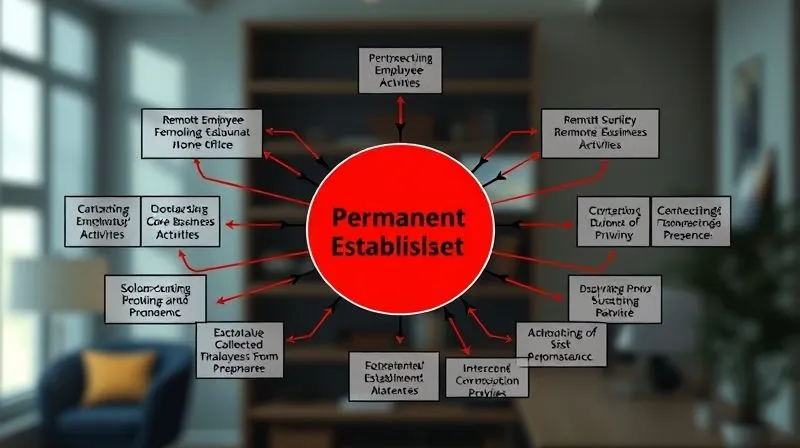
The challenge with remote employees is that their home office, or even their activities, can inadvertently create a PE for their employer. This can occur in several ways:
- Fixed Place PE: If an employee regularly uses their home office to conduct a significant part of the employer's core business activities, and the employer requires or provides the space, it could be deemed a fixed place of business.
- Dependent Agent PE: If an employee has the authority to conclude contracts in the name of the enterprise (not merely preparatory or auxiliary activities) and habitually exercises this authority in a foreign country, they can create a PE. This is particularly relevant for sales or business development roles.
- Service PE: Some tax treaties and domestic laws include 'service PE' provisions, where providing services for a certain period (e.g., 6 months within any 12-month period) can create a PE, even without a fixed place.
“Many companies mistakenly believe that merely having an employee work from their home abroad won't trigger PE. The reality is far more nuanced; it's about the nature of the activities, the duration, and the employer's involvement with that remote workspace.”
Case Study: How GlobalConnect Solutions Accidentally Triggered PE
GlobalConnect Solutions, a mid-sized software development firm based in the US, hired a senior developer, Maria, who insisted on working from her home in Germany. GlobalConnect provided Maria with a company laptop, a stipend for internet, and expected her to deliver critical code modules, interact directly with clients, and manage a small team of contractors – all from her German apartment. For two years, this arrangement went unchallenged. However, when German tax authorities conducted a routine audit of a local client of GlobalConnect, they uncovered Maria's activities. They argued that Maria's home office constituted a fixed place of business, and her role, being central to GlobalConnect's core operations and involving client interaction, was not merely 'preparatory or auxiliary'. GlobalConnect was subsequently assessed for corporate income tax in Germany for the past two years, along with significant penalties for non-compliance. This case highlights the urgent need to understand the international tax implications of remote employees abroad, especially concerning PE.
Navigating Payroll, Withholding & Social Security Across Borders
Beyond the corporate income tax implications of PE, employers must grapple with the complexities of managing payroll, withholding taxes, and social security contributions for their international remote workforce. This area presents immediate and ongoing compliance challenges.
Employer Obligations
When an employee works in a foreign country, the employer often acquires obligations in that country, regardless of whether a PE is triggered for corporate tax purposes:
- Local Payroll Registration: In many jurisdictions, you will need to register as an employer with local tax authorities and establish a local payroll. This can be a time-consuming and administratively heavy process.
- Withholding Taxes: You may be required to withhold local income tax from the employee's salary and remit it to the foreign government. The rates and rules vary significantly by country.
- Social Security Contributions: Employers typically must contribute to the foreign country's social security, pension, and unemployment schemes, often alongside employee contributions. These can be substantial and are country-specific.
- Tax Treaties: Bilateral tax treaties (like those based on the OECD model) can offer relief from double taxation and sometimes clarify which country has the primary taxing rights. However, invoking treaty benefits often requires specific forms (e.g., Form W-8BEN for non-US persons) and careful planning.
Employee Obligations
Employees also face their own set of tax obligations in their country of residence, and potentially in the employer's home country:
- Tax Residency Rules: The employee's tax residency determines where they are primarily liable for income tax. Dual residency can occur, requiring 'tie-breaker rules' in tax treaties to determine primary residency.
- Foreign Earned Income Exclusion (FEIE) / Foreign Tax Credit: For US citizens or residents working abroad, the IRS offers mechanisms like the FEIE or the Foreign Tax Credit to mitigate double taxation, but strict eligibility criteria apply. Other countries have similar provisions.
- Local Filings: Even if an employer handles withholding, employees typically need to file individual income tax returns in their country of residence.
Actionable Steps for Payroll Setup:
- Identify Employee Location: Confirm the exact country and even state/province where the employee resides and works.
- Research Local Laws: Understand the specific payroll, withholding, and social security requirements for that jurisdiction.
- Engage Local Expertise: Partner with local payroll providers or legal counsel to ensure compliance.
- Establish Payroll Entity: Determine if you need to register a local entity or use an Employer of Record (EOR) service.
- Implement Withholding: Set up accurate withholding calculations and remittance processes.
- Communicate Clearly: Inform employees of their tax obligations and how their pay is being processed.
Understanding these granular requirements is crucial for managing the urgent international tax implications of remote employees abroad.
| Obligation Type | Employer Home Country | Employee Host Country |
|---|---|---|
| Corporate Income Tax (PE) | No direct impact (unless PE in home country) | Potential liability if PE triggered |
| Payroll Withholding | Generally none, unless dual residency/treaty invoked | Required for local income tax |
| Social Security Contributions | Generally none (unless specific agreements) | Required for local social security/pension |
| VAT/GST (Service Nexus) | N/A for employee services | Potential liability if services deemed locally supplied |
The Nexus of VAT/GST: When Services Become Taxable Abroad
While often overshadowed by income tax and PE concerns, indirect taxes like Value Added Tax (VAT) in Europe or Goods and Services Tax (GST) in other regions can also present unexpected challenges for companies with remote employees abroad. The key concept here is 'service nexus' – determining where a service is deemed to be supplied for tax purposes.
Understanding Service Nexus
VAT/GST is generally a consumption tax, meaning it's levied on the value added at each stage of production and distribution of goods and services. For services, determining the 'place of supply' is critical. If your remote employee's activities in a foreign country lead to your company being considered as supplying services in that country, you might be required to register for and charge local VAT/GST, even if you don't have a formal PE for corporate income tax.
Impact on Remote Teams
Consider a scenario where a remote employee, based in an EU country, is primarily engaged in providing technical support or consulting services directly to clients located in that same EU country on behalf of a non-EU company. Depending on the specifics of the service, the client, and local regulations, the provision of these services might create a VAT nexus for your company in that EU country. This could necessitate VAT registration, filing, and remittance, adding another layer of complexity to your international tax obligations.
“Don't assume that because your company is not physically selling goods, you're immune to indirect tax obligations abroad. The provision of services by remote employees can, under specific circumstances, trigger VAT or GST registration requirements.”
The OECD International VAT/GST Guidelines provide a framework, but local interpretations vary. It's essential to analyze the nature of the services your remote employees provide and to whom they are provided to assess potential indirect tax risks. This is a subtle but significant aspect of the urgent international tax implications of remote employees abroad.
Mastering Tax Residency: The Employee's & Employer's Dilemma
Tax residency is a foundational concept in international taxation, determining where an individual is primarily liable for income tax. For remote employees, and consequently their employers, understanding and correctly establishing tax residency is paramount to avoiding double taxation and ensuring compliance.
Defining Tax Residency
Each country has its own rules for determining tax residency. These often involve factors such as:
- Physical Presence: Spending a certain number of days (e.g., 183 days) in a country during a tax year.
- Permanent Home: Having a dwelling available to you (owned or rented).
- Center of Vital Interests: Where your personal and economic ties are stronger (family, social life, business interests).
- Habitual Abode: Where you habitually live.
It's crucial to distinguish tax residency from immigration or legal residency. An individual can be legally permitted to reside in a country but not be a tax resident, or vice-versa, depending on their duration of stay and other factors.
Dual Residency & Tie-Breaker Rules
A common scenario for remote employees is 'dual residency,' where an individual meets the tax residency criteria of two or more countries simultaneously. This is where tax treaties become invaluable. Most treaties include 'tie-breaker rules' to determine a single country of tax residency for treaty purposes, typically following a hierarchy:
- Permanent home available.
- Center of vital interests.
- Habitual abode.
- Nationality.
- Mutual agreement by tax authorities.
Applying these rules can be complex and often requires detailed analysis of an individual's personal circumstances. Incorrectly determining an employee's tax residency can lead to incorrect withholding, non-compliance, and significant penalties for both the employee and the employer.
Impact on Employer Reporting
The employee's tax residency directly impacts the employer's payroll obligations. If an employee is a tax resident of Country A but works for a company in Country B, Country A will generally have the primary right to tax the employee's worldwide income. This means the employer in Country B may need to operate a payroll in Country A or ensure compliance with Country A's withholding rules, even if they don't have a corporate PE there. This intricate dance of tax residency is a key component of understanding the urgent international tax implications of remote employees abroad.

Crafting a Robust Global Mobility & Tax Compliance Strategy
Given the intricate and urgent international tax implications of remote employees abroad, a reactive approach is simply unsustainable. Organizations need a proactive, well-defined global mobility and tax compliance strategy. This isn't just about avoiding penalties; it's about enabling sustainable global growth and talent acquisition.
Step 1: Conduct a Comprehensive Risk Assessment
Begin by identifying where all your remote employees are located globally. For each location, assess the potential risks:
- PE Risk: Based on employee roles, activities, and duration.
- Payroll & Social Security: Local registration, withholding, and contribution requirements.
- VAT/GST Nexus: If services are provided locally.
- Immigration & Labor Law: Beyond tax, ensure legal right to work and local employment law compliance.
Step 2: Develop Clear Remote Work Policies
Your internal policies should clearly define the boundaries of remote work, especially internationally. Consider:
- Approved Jurisdictions: A list of countries where remote work is permitted, based on your risk assessment.
- Role Limitations: Which roles are suitable for international remote work (e.g., avoiding sales roles that could trigger PE).
- Duration Limits: For temporary international assignments, define maximum periods to avoid triggering residency or PE.
- Communication Protocols: How employees must inform HR/Legal of location changes.
Step 3: Leverage Technology and Expert Advisors
Navigating global tax laws is not a DIY project. Partner with:
- Global Payroll Providers: Specialists who can manage local payroll, withholding, and social security.
- Employer of Record (EOR) Services: For countries where you don't want to establish a legal entity, an EOR can hire and manage employees on your behalf, taking on the tax and legal burden.
- International Tax Counsel: Engage legal and tax experts to provide country-specific advice and ensure your strategy is robust. Firms like Deloitte Global Employer Services or KPMG offer such expertise.
- Global Mobility Software: Tools that track employee locations, residency status, and compliance requirements.
Step 4: Continuous Monitoring and Adaptation
International tax laws are dynamic. Your strategy must be too:
- Regular Reviews: Annually review your remote workforce locations and associated tax risks.
- Stay Informed: Monitor changes in tax legislation in relevant jurisdictions.
- Employee Education: Ensure employees understand their obligations and the company's policies.
Proactive planning and continuous vigilance are your best defense against the complexities of the urgent international tax implications of remote employees abroad. As marketing guru Seth Godin often says, "The cost of being wrong is so much higher than the cost of being right." In international tax, this couldn't be truer.
The Cost of Non-Compliance: Penalties, Audits, and Reputational Damage
Ignoring the urgent international tax implications of remote employees abroad is not merely a gamble; it's a direct path to significant financial and reputational harm. The consequences of non-compliance can be severe and far-reaching, impacting both your bottom line and your standing in the market.
Financial Penalties
The most immediate and tangible cost of non-compliance is financial. Tax authorities in foreign jurisdictions can impose:
- Back Taxes: You may be liable for unpaid corporate income tax, payroll taxes, social security contributions, or VAT/GST for previous periods.
- Interest: Accrued interest on underpaid taxes can quickly compound, adding substantially to the total liability.
- Fines and Penalties: These can be a fixed amount, a percentage of the underpaid tax, or even daily penalties for ongoing non-compliance. Some countries have particularly aggressive penalty regimes.
- Legal Fees: Defending against audits and navigating disputes with foreign tax authorities can incur substantial legal and consulting fees.
Reputational Harm
Beyond the financial hit, non-compliance can severely damage your company's reputation. Being publicly identified as non-compliant with tax laws can:
- Erode Trust: Clients, investors, and partners may lose trust in your organization's integrity and governance.
- Impact Talent Acquisition: Prospective employees might be wary of joining a company with a questionable compliance record, especially when it directly impacts their own tax situation.
- Regulatory Scrutiny: Non-compliance in one area can trigger broader regulatory scrutiny, leading to more extensive audits across different aspects of your business.
Operational Disruption
Dealing with audits, investigations, and legal challenges in foreign jurisdictions diverts valuable internal resources. HR, legal, finance, and even executive teams can become consumed by resolving these issues, taking focus away from core business objectives and strategic growth initiatives. This operational disruption can hinder productivity and innovation.
“Proactive compliance is not an expense; it's an investment in your company's stability, reputation, and long-term viability in a globalized world. The cost of prevention is always dwarfed by the cost of remediation.”
In my experience, the pain and expense of fixing non-compliance issues retrospectively are almost always far greater than the effort and cost of setting up a compliant framework from the outset. Understanding these potential ramifications underscores the true urgency of addressing the international tax implications of remote employees abroad.

Frequently Asked Questions (FAQ)
Can an employee's home office definitively create a Permanent Establishment (PE)? It's not definitive in all cases, but it's a significant risk. If the employee uses their home office regularly for core business activities, and the employer requires or provides the space (even implicitly through stipends or equipment), it can be argued that a PE exists. The nature of the employee's activities (e.g., contract negotiation, management responsibilities vs. purely preparatory tasks) is also crucial. Each case depends on the specific country's tax laws and interpretation of tax treaties.
What's the difference between tax residency and immigration residency? Immigration residency refers to an individual's legal right to live and work in a country (e.g., through a visa or permanent residency status). Tax residency, conversely, determines which country has the right to tax an individual's worldwide income. An individual can have immigration residency in one country but be a tax resident of another, or even be a tax resident of two countries simultaneously for a period. These are distinct legal concepts, and both must be managed for international remote employees.
How do tax treaties help with international tax implications? Tax treaties (also known as Double Taxation Agreements or DTAs) are bilateral agreements between two countries designed to prevent individuals and companies from being taxed twice on the same income. They clarify taxing rights, define concepts like Permanent Establishment, and provide 'tie-breaker rules' for dual residency. While invaluable, they don't eliminate all tax obligations; rather, they streamline them and provide a framework for relief mechanisms like foreign tax credits or exemptions.
What if an employee moves to another country without notifying us? This is a critical risk. An unannounced move can instantly trigger new tax obligations (PE, payroll, social security) for your company in the new country, often retroactively. It's imperative to have robust HR policies requiring employees to disclose and seek approval for any international relocation, clearly outlining the tax and legal consequences of non-compliance for both parties. Regular communication and clear guidelines are key.
What initial steps should a small business take if they have one or two remote employees abroad? Even for a small number of employees, the risks are real. Start by: 1) Identifying the exact countries of residence for all remote employees. 2) Conducting a preliminary risk assessment for PE and payroll obligations in those specific countries. 3) Consulting with an international tax specialist or engaging an Employer of Record (EOR) service to manage immediate compliance needs. Don't wait until an audit to address these urgent international tax implications of remote employees abroad.
Key Takeaways and Final Thoughts
Navigating the urgent international tax implications of remote employees abroad is undoubtedly complex, but it's no longer an optional consideration for businesses embracing a global workforce. The risks of non-compliance – from hefty financial penalties and back taxes to severe reputational damage – are too significant to ignore.
- Proactive Assessment is Key: Don't wait for an audit. Understand your global footprint and associated tax risks today.
- PE is Your Primary Concern: Carefully evaluate employee roles and activities to mitigate Permanent Establishment risks.
- Payroll & Social Security are Non-Negotiable: Establish compliant local payrolls or leverage EORs.
- Master Tax Residency: Ensure accurate determination for both employer and employee obligations.
- Invest in Expertise: Partner with international tax advisors and global mobility specialists.
- Policy & Communication: Implement clear remote work policies and educate your workforce.
The global remote work revolution offers unparalleled opportunities, but it demands a sophisticated understanding of international tax law. By embracing a proactive, informed, and strategically advised approach, you can transform these urgent challenges into a sustainable competitive advantage, ensuring your global team thrives without exposing your organization to unnecessary risk. Remember, clarity and compliance today pave the way for confident global expansion tomorrow.
Recommended Reading
- 7 Crucial Evidence Types: Uncovering Hidden Income in Child Support
- Unlock Your Future: How to Prepare for Chapter 7 Bankruptcy Filing Effectively
- Challenging Facially Neutral Laws with Disparate Racial Impact: A Legal Guide
- Unlock Success: Your Ultimate Guide to Preparing for a Sports Arbitration Hearing
- Recreational Boat Crash? Uncover the Essential Legal Steps You Must Take Now





Comments
Leave a comment below. Your email will not be published. Required fields marked with *