


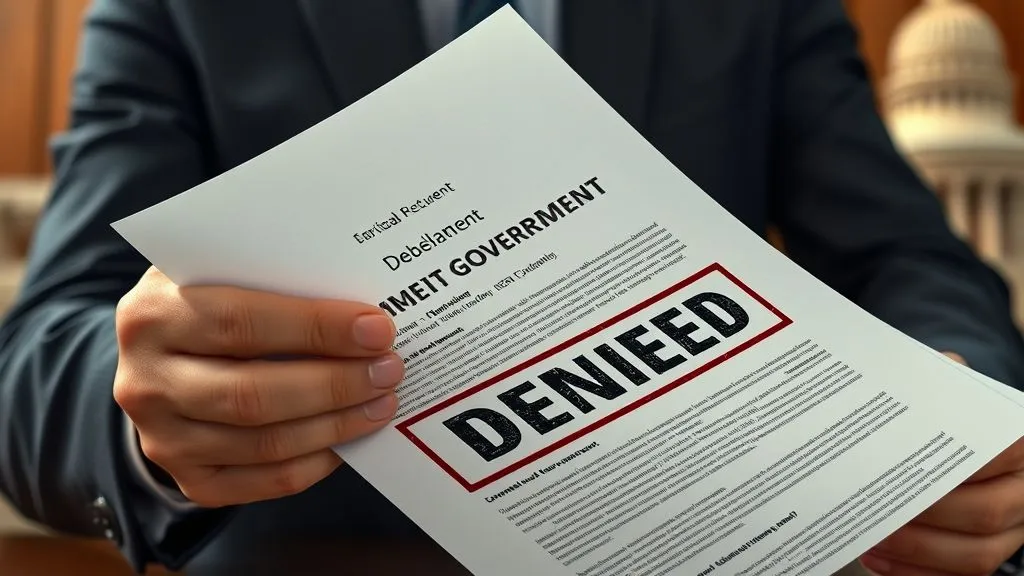
How to Appeal an Arbitrary Administrative Agency License Denial: Your Expert Playbook
For over two decades in administrative law, I've witnessed the profound impact an arbitrary license denial can have on individuals and businesses. It's not just a piece of paper; it's often the cornerstone of someone's livelihood, their dream, or their ability to contribute to society. I've seen promising ventures stalled and careers derailed, not due to incompetence or malfeasance, but by what often feels like the opaque, unfeeling hand of bureaucracy.
The frustration is palpable. You've poured your time, effort, and resources into an application, only to receive a denial that seems to lack sound reasoning, appears inconsistent with established rules, or is based on vague interpretations. This feeling of powerlessness against a monolithic government agency can be crushing, leaving many unsure where to turn or how to effectively challenge such a decision.
But here's a crucial insight I want to share: an administrative agency's decision, even a denial, is rarely the final word. This guide is your battle-tested playbook, drawing on years of navigating complex administrative processes. I'll provide you with a clear, step-by-step framework, real-world analogies, and expert insights to not just understand but confidently appeal an arbitrary administrative agency license denial and fight for your rights.
Understanding the Landscape: What Constitutes an 'Arbitrary' Denial?
Before you can effectively appeal, you must first understand the grounds for your challenge. An 'arbitrary' decision in administrative law generally means one that lacks a rational basis, is unsupported by substantial evidence, or is made without due consideration of relevant factors. It's not merely a decision you disagree with; it's one that falls outside the bounds of reasoned decision-making expected of a public body.
Common hallmarks of an arbitrary denial include: an agency failing to follow its own established procedures; relying on irrelevant factors; ignoring crucial evidence presented by the applicant; making a decision without any supporting factual record; or applying rules inconsistently compared to similar past cases. Conversely, a denial is generally not arbitrary if it's based on clear violations of statutes or regulations, or a well-documented failure to meet specific, published criteria.
Identifying that your denial truly qualifies as arbitrary is your foundational first step. It requires a careful, dispassionate review of the agency's stated reasons against the backdrop of their published rules and the evidence you provided. This critical analysis will form the bedrock of your appeal strategy.
Expert Insight: The burden of proof in challenging an arbitrary decision often falls on the appellant. You must demonstrate that the agency acted unreasonably, not merely that you prefer a different outcome. This requires meticulous evidence and a clear, logical argument.

Step 1: Immediate Actions – Preserve Your Rights and Gather Evidence
The moment you receive an administrative license denial, your immediate response is critical. Hesitation can lead to missed deadlines and forfeiture of rights. I’ve seen countless cases where a potentially winnable appeal was undermined by a failure to act swiftly and strategically in these initial hours and days.
Reviewing the Denial Letter Critically
Your denial letter is more than just bad news; it's your first piece of evidence and your roadmap for appeal. Read it meticulously, not just once, but several times, highlighting key sections.
- Date of Denial: This is paramount. It triggers your appeal clock. Every subsequent deadline will be calculated from this date.
- Stated Reasons for Denial: Identify every reason the agency provides. These are the specific points you will need to refute or challenge.
- Appeal Process and Deadline: The letter should outline the next steps for appeal, including the specific timeframe (e.g., 30 days from receipt). Mark this deadline prominently.
- Contact Information: Note who to contact for clarification or to initiate the appeal process.
Documenting Everything: The Paper Trail is Your Shield
In administrative law, the strength of your case often correlates directly with the completeness of your documentation. Every communication, every piece of evidence, every internal memo can be vital. Think of it as building an unassailable fortress of facts.
- Original Application & Supporting Documents: Keep a complete copy of everything you submitted.
- All Correspondence: Emails, letters, notes from phone calls (including date, time, and person spoken to).
- Agency's Internal Policies/Regulations: If referenced, obtain copies.
- Witness Statements: If applicable, gather sworn statements from individuals who can attest to facts relevant to your application.
- Expert Reports: Any professional opinions or evaluations that support your eligibility.
This meticulous record-keeping is not just good practice; it's a non-negotiable requirement. It helps you understand the agency's perspective, identify procedural errors, and present a coherent, evidence-backed argument. Remember, the better your paper trail, the stronger your position will be when you challenge the agency's decision. For federal agencies, the Administrative Procedure Act (APA) sets out baseline requirements for agency action, which can often be a powerful tool for appellants.
Step 2: Exhausting Administrative Remedies – The Internal Appeal Process
In nearly all administrative law scenarios, you cannot jump straight to court. You must first 'exhaust administrative remedies' – meaning you must complete the agency's internal appeal process. This isn't just a formality; it's an opportunity to present your case to a higher authority within the agency, often with fresh eyes, and build a comprehensive record for any subsequent judicial review.
Requesting a Formal Hearing or Review
Once you've reviewed your denial and gathered initial evidence, the next step is to formally initiate the agency's internal appeal process. This often involves requesting a hearing or a specific type of administrative review.
- Formal Request: Submit a written request for appeal or hearing, adhering strictly to the format and content requirements outlined in the denial letter or agency regulations.
- Understanding Procedures: Familiarize yourself with the specific rules governing administrative appeals for that agency. These can vary significantly. Are there specific forms? Is a pre-hearing conference required?
- Timeline Adherence: Strict adherence to all deadlines is crucial. A single missed deadline can be fatal to your appeal, regardless of the merits of your case.
Crafting Your Appeal: The Art of Persuasion
Your written appeal, whether it's a formal brief or a detailed letter, is your chance to articulate why the agency's denial was arbitrary or erroneous. This is where your meticulous documentation from Step 1 becomes invaluable.
- Address Each Stated Reason: Systematically respond to every reason for denial, presenting evidence and arguments to refute them.
- Highlight Factual Errors: Point out any factual inaccuracies the agency relied upon, providing your evidence to correct the record.
- Argue Legal Misinterpretations: If the agency misinterpreted a statute or regulation, explain why their interpretation is incorrect, citing relevant legal authority or agency precedent.
- Identify Procedural Defects: If the agency failed to follow its own rules or denied you due process, detail these procedural errors.
- Propose a Remedy: Clearly state what you want the agency to do – typically, reverse the denial and grant the license.
Case Study: How Atlas Innovations Overturned a Zoning Permit Denial
Atlas Innovations, a renewable energy startup, applied for a critical zoning permit for a new solar farm. Their application was denied, citing 'insufficient consideration of local aesthetic standards.' The denial letter was vague, and Atlas believed the decision was arbitrary given their extensive visual impact studies and community consultations. Their appeal strategy focused on:
- Meticulous Documentation: They had kept detailed records of all community meetings, visual simulations, expert landscape architect reports, and comparative data from other approved projects.
- Procedural Challenge: They discovered the agency's internal guidelines for 'aesthetic standards' were not publicly available and had been applied inconsistently in the past. They argued this lack of transparency and consistent application constituted a procedural defect.
- Expert Testimony: They brought in a recognized expert in environmental aesthetics who testified that their design not only met but exceeded industry standards, directly refuting the agency's vague claim.
After a detailed administrative hearing, the zoning board's internal review panel found the initial denial lacked a rational basis and was procedurally flawed due to the inconsistent application of unstated rules. The denial was overturned, allowing Atlas Innovations to proceed. This case perfectly illustrates the power of detailed preparation when you need to appeal an arbitrary administrative agency license denial.
| Component | Key Content | Checklist Item |
|---|---|---|
| Formal Appeal Request Letter | Reference denial date & case number, clearly state intent to appeal, request hearing. | Submitted by deadline |
| Statement of Grounds for Appeal | Systematically address each reason for denial, cite specific evidence. | All points addressed, evidence cross-referenced |
| Supporting Evidence Appendix | Copies of all relevant documents, photos, expert reports, affidavits. | Organized, paginated, indexed |
| Legal/Regulatory Citations (if applicable) | Specific statutes, regulations, or agency precedents that support your position. | Accurate and relevant citations |
| Proposed Remedy | Clearly state the desired outcome (e.g., license approval, remand for reconsideration). | Clearly articulated |
Step 3: Presenting Your Case – Administrative Hearings and Evidence
If your initial written appeal doesn't resolve the issue, you will likely proceed to an administrative hearing. This is your day in court, albeit often in a less formal setting. While it might feel intimidating, it's also your most significant opportunity to present your full case, directly challenge the agency's position, and build a robust record for any potential future appeals.
Preparing Your Argument and Witnesses
Thorough preparation is paramount. You need to anticipate the agency's arguments and prepare your rebuttals. In my experience, a clear, concise narrative supported by credible evidence is far more effective than a rambling, emotional plea.
- Develop a Clear Narrative: Outline the story of your application, the denial, and why it was arbitrary.
- Organize Your Evidence: Create an exhibit list and have copies ready for the hearing officer and the agency's representative.
- Prepare Your Witnesses: If you have witnesses, prepare them for direct examination (what they will say) and cross-examination (what the agency might ask). Ensure their testimony is factual and relevant.
- Anticipate Agency Arguments: Consider what the agency's legal counsel or representative will argue and prepare responses.
Navigating the Hearing Itself
Administrative hearings typically follow a structured format, though less formal than a court trial. Understanding the flow will help you remain composed and effective.
- Opening Statement: Briefly introduce yourself, your purpose, and what you intend to prove.
- Presentation of Evidence: Introduce your documents, present witness testimony, and explain how each piece supports your claim that the denial was arbitrary.
- Cross-Examination: The agency's representative will have the opportunity to question your witnesses and challenge your evidence.
- Agency's Case: The agency will then present its reasons for denial and any supporting evidence. You will have the opportunity to cross-examine their witnesses.
- Closing Statement: Summarize your arguments, reiterate why the denial was arbitrary, and clearly state the relief you seek.
Throughout the hearing, maintain a professional and respectful demeanor, even when facing challenging questions. Your credibility can significantly influence the hearing officer's decision. For further guidance on legal proceedings, resources like The American Bar Association's 'How Courts Work' can offer foundational insights into presenting a case.

Step 4: When Internal Appeals Fail – Seeking Judicial Review
If, despite your best efforts, the administrative agency upholds its arbitrary license denial through its internal appeal process, your next recourse is often judicial review. This means taking your case to a court of law. It's important to understand that courts typically grant a degree of deference to administrative agencies, meaning they won't simply re-decide the case from scratch. The bar for overturning an agency decision in court is higher, focusing more on the legality and rationality of the agency's process rather than just the outcome.
Grounds for Judicial Review
Courts generally review agency decisions to ensure they are lawful and reasonable. Common grounds for judicial review include:
- Arbitrary and Capricious: The agency acted without a rational basis, ignored relevant evidence, or made a decision that was clearly erroneous. This is often the primary ground for challenging an arbitrary administrative agency license denial.
- Abuse of Discretion: The agency exceeded its legal authority or made a decision that was plainly unreasonable given the facts.
- Ultra Vires: The agency acted outside the scope of its statutory powers.
- Constitutional Violations: The agency's decision or process violated your constitutional rights (e.g., due process, equal protection).
- Procedural Error: The agency failed to follow required procedures, prejudicing your case.
- Unsupported by Substantial Evidence: For fact-finding, the agency's decision is not supported by enough credible evidence in the record.
The Court Process: What to Expect
Seeking judicial review involves filing a petition with the appropriate court (usually a state circuit court or federal district court, depending on the agency). This is a formal legal process that almost always requires the assistance of an experienced attorney specializing in administrative law.
- Filing a Petition: Your attorney will file a petition for review, outlining the grounds on which you believe the agency's decision should be overturned.
- Standard of Review: The court will apply a specific standard of review (e.g., 'arbitrary and capricious,' 'substantial evidence,' 'de novo'). This dictates how closely the court will scrutinize the agency's decision.
- Review of the Administrative Record: The court will primarily review the record created during the administrative appeal process. New evidence is rarely permitted unless it's to prove a procedural defect.
- Oral Arguments: Attorneys for both sides will present oral arguments to the judge, explaining why the agency's decision should be upheld or overturned.
- Court Decision: The court can affirm the agency's decision, reverse it, or remand the case back to the agency for further proceedings consistent with the court's findings.
Expert Insight: Courts generally defer to an agency's expertise in its specific domain. To succeed in judicial review, you must demonstrate not just that the agency made a mistake, but that it acted outside its legal authority or in a manner that was clearly arbitrary or irrational, not merely that you disagree with the outcome. This is why a strong administrative record is so vital.
Understanding the nuances of judicial review is critical. For deeper legal scholarship on the topic, academic resources such as articles found on The Georgetown Law Journal or other university law reviews can offer invaluable insights into the evolving landscape of administrative law.
Expert Strategies for Maximizing Your Chances
Beyond the procedural steps, certain strategic approaches can significantly enhance your likelihood of success when you appeal an arbitrary administrative agency license denial. These are insights born from years of navigating the intricacies of bureaucratic systems.
The Power of Legal Counsel
While some initial steps can be managed independently, engaging an attorney specializing in administrative law is almost always a wise investment, particularly as the appeal progresses to formal hearings or judicial review. An experienced attorney brings:
- Procedural Expertise: They know the specific rules, deadlines, and unwritten expectations of the agency.
- Legal Acumen: They can identify the strongest legal arguments, cite relevant case law, and effectively challenge the agency's legal interpretations.
- Advocacy Skills: They are skilled in presenting evidence, cross-examining witnesses, and crafting persuasive arguments.
- Objective Perspective: They can provide dispassionate advice, crucial when you are emotionally invested in the outcome.
Understanding Agency Culture and Precedent
Agencies, like any large organization, have their own cultures, priorities, and historical precedents. Researching past decisions by the same agency or hearing officers can provide valuable insights into their typical reasoning, what arguments they find persuasive, and what evidence they deem critical. This isn't always easy to uncover, but a skilled attorney often has access to or knowledge of these unwritten rules and historical patterns.
Maintaining Professionalism and Persistence
Throughout the entire appeal process, maintain a professional and respectful demeanor. While your frustration might be immense, emotional outbursts or aggressive tactics are almost always counterproductive. Focus on the facts, the law, and the procedural integrity of the process. Bureaucratic systems can be slow, but persistence, coupled with a well-reasoned argument, often pays off.

Common Pitfalls to Avoid in Administrative Appeals
Even with a strong case, certain missteps can jeopardize your appeal. I've observed these pitfalls repeatedly, and avoiding them is as crucial as making the right moves.
- Missing Deadlines: This is the most common and often fatal error. Administrative deadlines are strict and usually non-negotiable.
- Insufficient Evidence: Relying on vague statements or personal belief without concrete, documented proof will weaken your case significantly.
- Emotional Arguments Over Factual/Legal Ones: While your frustration is understandable, administrative appeals are decided on facts and law, not sentiment.
- Failure to Exhaust Administrative Remedies: Trying to go straight to court without completing the agency's internal process will almost certainly lead to dismissal.
- Lack of Specificity: Vague claims that the denial was 'unfair' or 'wrong' are ineffective. You must specifically articulate how it was arbitrary, citing evidence and legal principles.
- Not Understanding the Agency's Regulations: Ignorance of the specific rules governing your license and the appeal process can lead to procedural errors on your part.
Expert Insight: Treat every deadline as sacred. If you're unsure, confirm it. If you foresee a problem, communicate proactively and seek extensions in writing, well in advance. A timely, well-organized appeal has a far greater chance of success than a rushed, last-minute submission, no matter how compelling your argument.
| Mistake | Consequence | Solution |
|---|---|---|
| Missing Appeal Deadlines | Forfeiture of appeal rights | Calendar all deadlines immediately, seek extensions proactively |
| Submitting Insufficient Evidence | Weakens case, fails to meet burden of proof | Gather all relevant documents, sworn statements, expert reports |
| Focusing on Emotion, Not Law/Fact | Perceived as unprofessional, unpersuasive | Ground arguments in statutes, regulations, agency policies, and verifiable facts |
| Failing to Exhaust Remedies | Case dismissed by court for lack of jurisdiction | Complete all internal agency appeal levels before seeking judicial review |
| Lack of Specificity in Arguments | Agency/court cannot understand precise challenge | Articulate specific factual errors, legal misinterpretations, or procedural defects |
Frequently Asked Questions (FAQ)
What's the difference between an 'arbitrary' and an 'illegal' denial? An 'illegal' denial means the agency acted outside its statutory authority or violated a specific law. An 'arbitrary' denial, while potentially illegal, specifically refers to a decision made without a rational basis, without considering relevant factors, or in a way that is clearly unreasonable or inconsistent with evidence. All illegal denials are arbitrary, but not all arbitrary denials are necessarily illegal in the sense of violating a specific statute; they might just be poorly reasoned.
Do I need a lawyer for an administrative appeal? While you can often initiate an appeal yourself, especially at the earliest stages, I strongly recommend retaining an attorney specializing in administrative law for formal hearings or judicial review. The legal complexities, evidentiary rules, and procedural nuances can be overwhelming, and an experienced lawyer significantly increases your chances of success.
How long does the administrative appeal process usually take? The timeline varies greatly depending on the agency, the complexity of the case, and whether judicial review is ultimately sought. An internal agency appeal might take a few months to over a year. If it proceeds to court, judicial review can add another year or more. Patience and persistence are key.
Can I introduce new evidence at different stages of the appeal? Generally, you should present all relevant evidence at the earliest possible stage, ideally during the initial application or the first level of internal appeal. While some agencies may allow new evidence at later stages or hearings, courts reviewing agency decisions are usually limited to the administrative record already established. It's best practice to make your case as complete as possible from the outset.
What if the agency simply ignores my appeal? While rare, if an agency completely fails to respond or process your appeal within reasonable regulatory or statutory timeframes, it could be grounds for a 'writ of mandamus' or a similar legal action in court, compelling the agency to act. This is a complex legal maneuver and definitely requires an attorney. Document all attempts to communicate and adhere to deadlines.
Key Takeaways and Final Thoughts
Facing an arbitrary administrative agency license denial can feel like hitting a brick wall. The bureaucratic maze, the legalese, and the sheer power imbalance can be daunting. However, as an industry specialist who has navigated these waters for decades, I can assure you that with the right approach, diligence, and expert guidance, these walls can often be scaled or circumvented.
- Act Swiftly and Document Everything: Your immediate response and meticulous record-keeping are your most potent weapons.
- Understand the 'Arbitrary' Standard: Focus your arguments on demonstrating a lack of rational basis, not just disagreement.
- Exhaust Administrative Remedies: Use the internal appeal process to build your strongest case and record.
- Prepare for Hearings: Treat administrative hearings as serious legal proceedings, with organized evidence and clear arguments.
- Consider Legal Counsel: An experienced administrative law attorney is invaluable, especially for complex cases or judicial review.
- Stay Professional and Persistent: Your demeanor and unwavering commitment to the process can make a significant difference.
Remember, the system is designed to be challenged, and your right to due process is fundamental. Don't let an arbitrary decision dictate your future. Equip yourself with this knowledge, take the necessary steps, and fight for the license you rightfully deserve. Your persistence and strategic approach can, and often do, lead to a successful outcome.
Recommended Reading
- Proving Miranda Violations: 7 Strategies Against Ambiguous Waivers
- Navigating Sudden Regulatory Shifts: 7 Strategies to Shield Your Business
- Due Diligence: Uncover Hidden Property Problems Before You Buy!
- 7 Strategies: Justifying Risky Reaffirmation Agreements to Judges
- 6 Strategies to Prevent Accidental Endangered Species 'Take' Risks




Comments
Leave a comment below. Your email will not be published. Required fields marked with *