


How to Apportion Fault in Multi-Vessel Sea Collisions?
For over three decades in maritime law, I've navigated countless scenarios involving vessels at sea. While single-vessel incidents present their own challenges, it’s the multi-vessel sea collision that truly tests the mettle of investigators and legal teams. The intricate web of interactions, duties, and potential failures makes these cases exceptionally complex.
The immediate aftermath of such a collision often descends into a legal quagmire, with each party seeking to minimize their liability while maximizing their claim. The financial stakes are immense, involving hull damage, cargo loss, environmental impact, and potentially, loss of life. Getting the apportionment of fault right is not just a legal exercise; it’s a moral imperative that dictates justice and sets precedents for future maritime safety.
This guide aims to demystify the process of apportioning fault in multi-vessel sea collisions. Drawing upon my extensive experience, I will provide a structured framework, delving into the foundational principles of maritime law, critical investigative techniques, and a practical model for fault allocation. You'll gain actionable insights, illustrated with real-world analogies and a fictional case study, to help you understand this challenging aspect of maritime law.
The Labyrinth of Multi-Vessel Collisions: Why It's So Complex
Unlike a collision between just two vessels, where the focus is primarily on the interaction between those two parties, multi-vessel incidents introduce a geometric progression of complexity. The involvement of a third, fourth, or even fifth vessel exponentially complicates the analysis of causation and responsibility. Each vessel's actions, or inactions, can have cascading effects on others.
In my experience, what often appears as a straightforward chain of events quickly unravels into a tangled knot of overlapping duties and contributing factors. This makes answering the question, how to apportion fault in multi-vessel sea collisions?, a formidable task. Here are some reasons why these cases are particularly challenging:
- Multiple Parties and Interacting Duties: Each vessel has its own set of obligations under the International Regulations for Preventing Collisions at Sea (COLREGs), and these duties can overlap or conflict in dynamic situations.
- Cascading Events: An initial error by one vessel might force evasive action from another, which then inadvertently puts a third vessel at risk, creating a domino effect of incidents.
- Overlapping Jurisdictions: Multi-vessel collisions can involve vessels from different flags, occurring in international waters or the territorial seas of various nations, complicating legal proceedings and choice of law.
- Diverse Vessel Types: A collision might involve a supertanker, a fishing trawler, and a recreational yacht, each with different operational characteristics, manœuvrability, and navigational capabilities.
Foundational Principles: The Role of COLREGs and Maritime Law
At the heart of any collision investigation lies the International Regulations for Preventing Collisions at Sea, universally known as the COLREGs. These rules are the bedrock upon which fault is assessed. They dictate everything from maintaining a proper lookout to safe speed, right-of-way, and actions to avoid collision.
"The COLREGs are not merely rules; they are the universal language of safe navigation at sea. Any deviation, however minor, can have profound implications for fault in a collision."
Understanding and applying these rules is paramount. However, the COLREGs are not exhaustive; they are supplemented by principles of good seamanship and customary maritime practice, which are often invoked when specific rules do not directly apply or when their interpretation requires expert judgment.
Key COLREGs for Fault Assessment
When I analyze a multi-vessel collision, I always start by meticulously dissecting each vessel's compliance, or non-compliance, with these fundamental rules:
- Rule 2 (Responsibility): Emphasizes the general responsibility for safe navigation and adherence to good seamanship, even if it means departing from other rules to avoid immediate danger.
- Rule 5 (Look-out): Mandates that every vessel shall at all times maintain a proper look-out by sight and hearing, as well as by all available means appropriate to the prevailing circumstances and conditions.
- Rule 6 (Safe Speed): Requires vessels to proceed at a safe speed, taking into account factors like visibility, traffic density, and the manoeuvrability of the vessel.
- Rule 7 (Risk of Collision): Details how to determine if a risk of collision exists, primarily through systematic observation of radar and visual bearings.
- Rule 8 (Action to Avoid Collision): Specifies actions to be taken to avoid collision, emphasizing clear, bold, and timely alterations of course and/or speed.
- Rule 19 (Conduct of Vessels in Restricted Visibility): Provides specific guidance for vessels navigating in fog, heavy rain, or other conditions of restricted visibility, often a major factor in multi-vessel incidents.
For a comprehensive understanding, I always recommend referring directly to the official regulations: International Maritime Organization (IMO) COLREGs.
The Investigative Blueprint: Gathering Critical Evidence
Accurately apportioning fault hinges entirely on the quality and completeness of the evidence gathered. In my experience, the initial hours and days following a collision are absolutely crucial. This is when vital data can be secured or irrevocably lost. A thorough, systematic investigation is non-negotiable.
My approach is akin to assembling a complex jigsaw puzzle, where every piece of data, no matter how small, contributes to the overall picture. Without robust evidence, any attempt to answer how to apportion fault in multi-vessel sea collisions? remains speculative.
Step-by-Step Evidence Collection
Here’s a blueprint I follow for critical evidence collection:
- VDR/AIS Data Analysis: The Voyage Data Recorder (VDR) is the 'black box' of a ship. It records bridge audio, radar images, engine commands, rudder angles, and GPS data. The Automatic Identification System (AIS) provides vessel identity, position, course, and speed. Meticulously analyzing these records allows for a precise reconstruction of events leading up to and during the collision.
- Bridge Team Debriefings & Witness Statements: Immediate, objective interviews with all crew members involved, particularly the bridge teams, are vital. Their perceptions, actions, and communications provide crucial human context. Care must be taken to separate objective observation from subjective interpretation.
- Damage Surveys: Independent marine surveyors must inspect all involved vessels to document physical damage. The nature, location, and extent of damage can reveal angles of impact, speeds, and forces involved, corroborating or contradicting VDR/AIS data.
- Navigational Charts & Publications: A review of the vessels' planned routes, actual tracks, and any relevant Notices to Mariners or navigational warnings provides context for their movements and any deviations.
- Weather & Environmental Data: Official meteorological reports, sea state data, and tidal information for the time and location of the incident are essential. These external factors can significantly influence visibility, manoeuvrability, and the overall risk assessment.
- Crew Competency & Fatigue Records: Investigations often extend to crew certifications, training records, watchkeeping schedules, and rest hours. Fatigue or lack of proper training can be significant contributing factors to human error.
Collecting this data systematically ensures that no stone is left unturned in the pursuit of the truth.
Causation and Contributory Negligence: Unpacking the 'Why'
Once the evidence is meticulously gathered, the next critical step is to establish causation – understanding *why* the collision occurred. This involves identifying the direct and indirect actions or inactions of each vessel that contributed to the incident. It's rarely a single cause but rather a confluence of factors.
Defining Legal Causation
In maritime law, causation typically involves two main aspects:
- Factual Causation (The 'But-For' Test): Would the collision have occurred *but for* the specific action or inaction of a vessel? If the answer is no, then that action is a factual cause.
- Legal Causation (Proximity and Foreseeability): Even if an action is a factual cause, it must also be a legal cause. This considers whether the harm was a reasonably foreseeable consequence of the action and if there was a sufficiently close connection between the action and the collision.
In multi-vessel scenarios, establishing causation for each vessel requires careful disentanglement of intertwined events.
The Doctrine of Contributory Negligence
The concept of contributory negligence is central to apportioning fault. It acknowledges that multiple parties can be at fault, and their respective degrees of blame must be assessed. Unlike some jurisdictions where contributory negligence might bar recovery, maritime law generally allows for the apportionment of damages based on the degree of fault.
This means that even if your vessel was partly at fault, you can still recover a portion of your damages from other negligent parties. The challenge lies in quantifying that percentage of fault fairly and robustly. As the Brussels Collision Convention of 1910, which underpins much of international maritime collision law, states, liability is to be apportioned "in proportion to the degree of the faults respectively committed."
To illustrate how different factors contribute to fault, consider this simplified view:
| Factor | Contribution to Collision | COLREGs Violation | Apportionment Impact |
|---|---|---|---|
| Vessel A - Lookout | Failed to maintain proper lookout | Rule 5 | High |
| Vessel B - Speed | Excessive speed in restricted visibility | Rule 6, Rule 19 | Medium |
| Vessel C - Communication | Failure to use VHF to clarify intentions | Rule 2(a), Good Seamanship | Low to Medium |
The Apportionment Framework: A Structured Approach to Fault Allocation
Having established causation for each vessel, the pivotal step is to assign a percentage of fault. This is where the art and science of maritime law truly converge. Over the years, I've developed a multi-factor model that helps me systematically evaluate and quantify each vessel's contribution. It moves beyond a simple checklist to a nuanced assessment.
My 5-Factor Apportionment Model
When I advise clients on how to apportion fault in multi-vessel sea collisions?, I guide them through these five critical factors:
- Severity of COLREGs Violations: How egregious were the breaches of the International Regulations for Preventing Collisions at Sea? A clear violation of a fundamental rule (e.g., Rule 5 - Look-out, or Rule 8 - Action to Avoid Collision) often carries significant weight.
- Degree of Departure from Good Seamanship: Beyond specific COLREGs, did a vessel's crew fail to exercise the care and skill expected of a competent mariner in similar circumstances? This encompasses aspects like poor bridge resource management, inadequate passage planning, or a general lack of situational awareness.
- Causative Potency: How directly and significantly did each vessel's fault contribute to the *actual* collision? Some faults might be technical violations but have little direct causative impact, while others are the immediate trigger for the incident.
- Foreseeability of Harm: Could the crew have reasonably foreseen that their actions or inactions would lead to a collision? A high degree of foreseeability, coupled with a failure to act, increases culpability.
- Mitigating/Aggravating Factors: Were there any external circumstances that lessened or worsened a vessel's fault? This could include sudden, unforeseeable equipment failure (mitigating) or gross negligence, such as operating under the influence (aggravating).
"Apportionment is rarely a clean 50/50 split, especially in multi-vessel scenarios. It's a nuanced balancing act, weighing the gravity, causative impact, and foreseeability of each vessel's failures to arrive at a just percentage."
This systematic approach helps to avoid arbitrary decisions and provides a defensible basis for fault allocation, crucial for insurance claims and legal proceedings.
Case Study: Navigating the 'Sea Serpent' and 'Ocean Queen' Incident
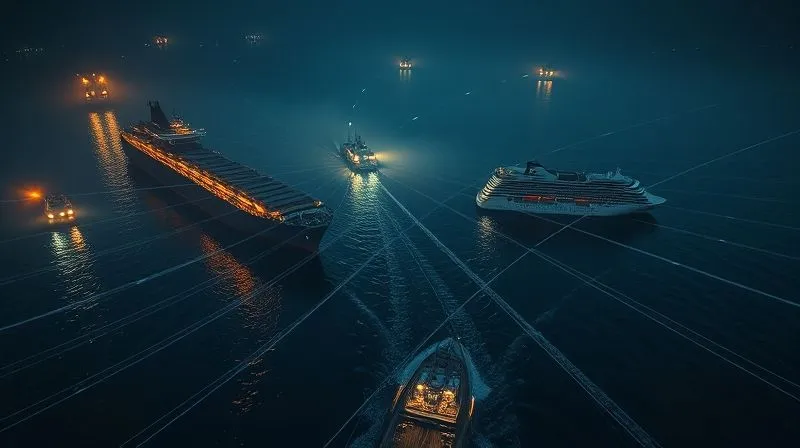
Let me illustrate this framework with a fictional, yet highly realistic, scenario that mirrors cases I've encountered. Imagine a busy shipping lane in an area prone to fog, like the English Channel. Our players are the container ship 'Sea Serpent', the cruise liner 'Ocean Queen', and a small fishing vessel 'Lucky Star'.
One foggy morning, visibility drops sharply. The 'Sea Serpent', a large container vessel, is proceeding at a speed slightly above the safe limit for the conditions (violating Rule 6). Its radar watch is intermittent, and the bridge team is distracted, failing to maintain a proper lookout (Rule 5). The 'Ocean Queen', a cruise liner, is also moving too fast for the restricted visibility and fails to take early, substantial action to avoid a risk of collision with an unidentified target on its radar (Rule 6, Rule 8). The 'Lucky Star', a small fishing vessel, is operating in the congested lane without its AIS transmitting, making it difficult for larger vessels to track.
The 'Sea Serpent' eventually sights the 'Ocean Queen' visually at close range and executes a drastic, unannounced starboard turn. This unexpected manoeuvre puts it directly into the path of the 'Ocean Queen', which then has no time to react effectively. The 'Ocean Queen' attempts an emergency port turn, but a glancing collision occurs. In the confusion, the 'Lucky Star', which was attempting to cross the channel, is caught in the wash and suffers minor damage, though it avoids a direct hit.
Applying my 5-factor model:
- 'Sea Serpent': Gross violations of Rule 5 (lookout) and Rule 6 (safe speed), plus a highly dangerous Rule 8 manoeuvre (drastic turn without warning). High causative potency. High foreseeability of harm. Result: Significant fault.
- 'Ocean Queen': Violation of Rule 6 (safe speed) and Rule 8 (failure to take early, substantial action). While its actions were reactive, its initial speed and delayed response contributed significantly. Medium-high causative potency. Medium foreseeability. Result: Moderate fault.
- 'Lucky Star': Failure to transmit AIS in a congested area (a breach of good seamanship and potentially local regulations). While not directly causing the collision, its 'invisibility' exacerbated the situation for the larger vessels. Low causative potency. Result: Minor fault.
Based on this analysis, the fault might be apportioned as: Sea Serpent 60%, Ocean Queen 35%, Lucky Star 5%. This case study highlights that even minor contributing factors from a third party can play a role in the overall apportionment.
Legal Precedents and International Conventions
While the COLREGs provide the operational rules, the legal framework for apportioning fault is often shaped by international conventions and the jurisprudence of admiralty courts. The aforementioned Brussels Collision Convention of 1910 is particularly influential, as it established the principle of proportionate liability based on the degree of fault.
Many national maritime laws, including those in the United States, the UK, and across Europe, derive their principles of contributory negligence and fault apportionment from this convention. Courts interpret "degree of fault" by examining all evidence, expert testimony, and applying established legal principles. They often consider not only the number of rules violated but also the gravity and causative effect of each violation.
Understanding these precedents is crucial because judges and arbitrators will look to similar cases to guide their decisions. The goal is always to achieve an equitable outcome that reflects each party's true contribution to the incident. For further reading on the foundational legal text, I recommend reviewing the International Convention for the Unification of Certain Rules of Law with respect to Collision between Vessels (Brussels, 1910).
The Role of Expert Witnesses and Litigation
In complex multi-vessel collision cases, the involvement of expert witnesses is not merely beneficial; it's often indispensable. These specialists provide the technical, operational, and legal insights necessary to translate raw data into compelling arguments for fault apportionment. From my vantage point, they are the interpreters of the maritime world for the courts.
Their expertise can make or break a case, especially when trying to answer how to apportion fault in multi-vessel sea collisions? with precision. Here are some key types of experts:
- Nautical Surveyors: Assess physical damage, stability, and seaworthiness.
- VDR/AIS Analysts: Reconstruct vessel movements, speeds, and communications.
- Marine Engineers: Evaluate engine performance, machinery failures, and their impact.
- Meteorologists/Oceanographers: Provide detailed weather, current, and tidal data.
- Navigational Experts: Offer opinions on compliance with COLREGs and standards of good seamanship.
- Salvage Experts: Advise on salvage operations and associated costs.
Preparing for Litigation
Effective litigation preparation involves more than just gathering facts. It requires a strategic approach to presenting evidence, challenging opposing arguments, and leveraging expert testimony. Early engagement with experts, meticulous documentation, and a clear, concise narrative are paramount. The goal is to build an unassailable case for your client's position on fault apportionment.
| Expert Type | Primary Role | Evidence Provided |
|---|---|---|
| Nautical Surveyor | Damage assessment, vessel stability | Physical damage reports, stability calculations |
| VDR/AIS Analyst | Reconstruct vessel movements, speed, course | Timeline of events, graphical representations of tracks |
| Meteorologist | Analyze weather conditions | Historical weather data, visibility reports |
| Navigational Expert | Assess COLREGs compliance, good seamanship | Expert opinions on watchkeeping, maneuver decisions |
Mitigating Future Risks: Lessons Learned
Every collision, no matter how tragic or complex, offers invaluable lessons. My role extends beyond just resolving disputes; it's also about preventing future incidents. Understanding how to apportion fault in multi-vessel sea collisions? is not just about assigning blame, but about identifying systemic weaknesses and promoting safer maritime practices.
From the insights gained through countless investigations, I've observed that several proactive measures can significantly reduce the risk of multi-vessel collisions:
- Enhanced Bridge Resource Management (BRM): Promoting effective communication, leadership, and teamwork on the bridge, ensuring all available resources (human and technical) are optimally utilized.
- Continuous Training and Education: Regular refreshers on COLREGs, radar/ARPA usage, and emergency procedures are vital. Simulation training for complex scenarios is particularly effective.
- Technological Upgrades: Investing in advanced navigation systems, improved radar capabilities, and integrated bridge systems can provide better situational awareness.
- Robust Safety Management Systems (SMS): Implementing and strictly adhering to comprehensive SMS, including regular audits and drills, fosters a culture of safety throughout the organization.
- Clear Communication Protocols: Establishing and practicing clear VHF communication protocols, especially in congested waters or restricted visibility, can prevent misunderstandings.
Ultimately, a proactive safety culture, underpinned by rigorous training and adherence to international regulations, is the most effective deterrent against the devastating consequences of multi-vessel sea collisions.
Frequently Asked Questions (FAQ)
Q: What if one vessel is clearly much larger than another in a multi-vessel collision? Does size impact fault apportionment? A: While size itself doesn't automatically assign more fault, it often correlates with greater manoeuvrability limitations and larger potential for damage. A larger vessel might have a greater obligation to take early, substantial action due to its inertia, but fault is still primarily based on COLREGs violations and causative factors, not just physical dimensions. However, Rule 18 (Responsibilities between vessels) does prioritize certain vessels, like vessels not under command, over others.
Q: How does human error factor into fault apportionment in multi-vessel incidents? A: Human error is almost always a significant factor. It can manifest as poor lookout, incorrect interpretation of radar, delayed decision-making, fatigue, or a lack of understanding of COLREGs. In my experience, a majority of collisions trace back to human element failures. The investigation will dissect how each human error contributed to the chain of events and assign fault accordingly.
Q: Can a vessel be 100% at fault in a multi-vessel sea collision? A: While less common in multi-vessel scenarios due to the increased complexity of interactions, it is legally possible for one vessel to be found 100% at fault if its actions were the sole, proximate cause of the collision, and other vessels acted entirely prudently or their actions were non-causative. However, in practice, courts often find some degree of contributory negligence, even minor, in at least two parties.
Q: What's the difference between 'fault' and 'liability' in maritime law? A: 'Fault' refers to the blameworthiness or negligence of a party in causing the collision, often expressed as a percentage. 'Liability' refers to the legal obligation to pay damages resulting from that fault. While closely related, they are distinct. For example, a vessel might be found 50% at fault, but its liability might be capped by international conventions like the LLMC (Convention on Limitation of Liability for Maritime Claims) or limited by insurance terms.
Q: How does jurisdiction affect fault apportionment in international waters? A: In international waters, the choice of law can be complex. Often, the law of the forum (where the case is heard) will apply, but principles from international conventions like the Brussels Collision Convention of 1910 are widely adopted. If vessels from different flags are involved, or the collision occurs in a specific nation's territorial waters, the legal framework can become even more intricate, requiring expert legal counsel familiar with various admiralty jurisdictions.
Key Takeaways and Final Thoughts
Navigating the legal complexities of multi-vessel sea collisions is undoubtedly one of the most challenging aspects of maritime law. It demands a meticulous, evidence-based approach and a deep understanding of both operational realities and legal principles. From my decades on the front lines, I can confidently say that there there are no shortcuts to accurate fault apportionment.
- The COLREGs are Your Compass: Always revert to these foundational rules as the primary benchmark for assessing navigational conduct.
- Evidence is King: A thorough, timely, and systematic collection of VDR, AIS, witness, and survey data forms the bedrock of any successful case.
- Causation is Key: Distinguish between factual and legal causation to understand *why* each vessel's actions contributed to the incident.
- Structured Apportionment: Utilize a multi-factor model, considering severity of violations, good seamanship, causative potency, foreseeability, and mitigating/aggravating factors.
- Expertise is Essential: Leverage the knowledge of expert witnesses to translate complex maritime data into clear, defensible arguments.
Ultimately, the pursuit of justice in these complex cases is about reconstructing the truth, understanding the interplay of human decisions and technological data, and applying established legal principles fairly. By adhering to these principles, we can ensure that lessons are learned, accountability is upheld, and the safety of our seas is continually improved. It’s a challenging journey, but one that is absolutely vital for the maritime industry.
Recommended Reading
- Probation Violation Hearing: Your 7-Step Immediate Legal Strategy
- 7 Strategies to Shield Directors from Corporate Misconduct Liability
- Navigating Legal Protocols: Essential Guide to Campus Active Shooter Drills
- 5 Proven Strategies: How to Avoid Parole Revocation After a Technical Violation
- 7 Proven Strategies: Overcoming Chapter 7 Trustee Exemption Objections

Comments
Leave a comment below. Your email will not be published. Required fields marked with *