


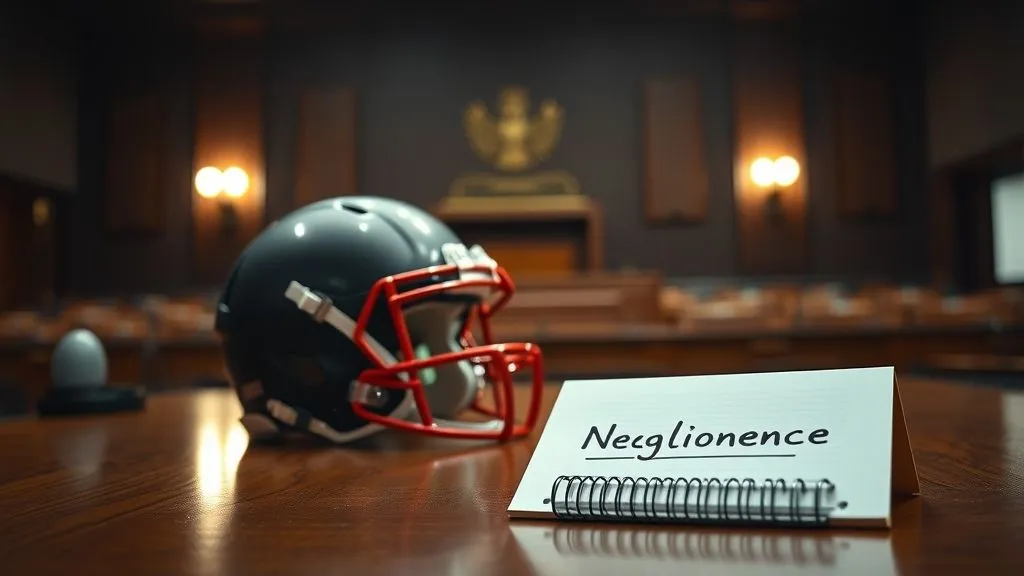
Proving Team Negligence in Sports Concussion Injury Lawsuit? My Expert Framework
For over two decades in the niche world of sports law, I've witnessed firsthand the devastating impact of sports-related concussions, not just on an athlete's career, but on their entire life. The legal landscape surrounding these injuries is complex, often fraught with emotional weight and significant financial implications. Many assume that a concussion is simply part of the game, but when negligence plays a role, that assumption crumbles, and the path to justice becomes paramount.
The challenge for injured athletes and their families isn't merely identifying a concussion; it's meticulously demonstrating that a team, organization, or even individual staff members failed in their duty of care. This isn't a straightforward task. It requires a deep understanding of medical science, sports protocols, legal precedents, and the often-subtle nuances of team operations. The emotional toll of these injuries can often overshadow the critical need for a strategic legal approach.
This article isn't just a guide; it's a framework born from years of navigating these intricate cases. I will walk you through the essential elements of proving team negligence in a sports concussion injury lawsuit, providing actionable steps, real-world analogies, and expert insights to help you understand the legal journey ahead. My goal is to equip you with the knowledge to discern when a team's actions (or inactions) cross the line from acceptable risk to actionable negligence, and how to build a robust case for accountability.
Understanding the Foundation: Duty of Care in Sports
Before we can prove negligence, we must first establish the existence of a duty of care. In sports, this isn't a nebulous concept; it's a concrete legal obligation that teams, coaches, medical staff, and even athletic organizations owe to their athletes. This duty requires them to act as a reasonably prudent entity would under similar circumstances to prevent foreseeable harm.
What constitutes 'foreseeable harm' has evolved dramatically with our understanding of concussions. Gone are the days when 'getting your bell rung' was dismissed. Now, the scientific community, and by extension, the legal system, recognizes the serious, long-term consequences of traumatic brain injuries. This heightened awareness directly impacts the standard of care expected.
- Coaches: Duty to teach proper technique, enforce rules, and recognize signs of injury.
- Medical Staff: Duty to diagnose, treat, and manage injuries, including adherence to return-to-play protocols.
- Organizations/Teams: Duty to provide safe equipment, implement and enforce concussion protocols, and educate staff and athletes.
"The expansion of scientific knowledge regarding concussions has fundamentally shifted the legal definition of 'reasonable care' in sports. Ignorance is no longer a viable defense."
Element One: Establishing a Breach of Duty
Once duty of care is established, the next critical step in proving team negligence in a sports concussion injury lawsuit is demonstrating a breach of that duty. This means showing that the team or its representatives failed to meet the established standard of care. This failure can manifest in numerous ways, from direct actions to glaring omissions.
I've seen cases where a coach pressured an athlete to return to play too soon, despite clear concussion symptoms. Other times, the breach might be systemic, such as a team lacking any formal concussion protocol or using outdated, unsafe equipment. It's about identifying the specific act or failure to act that falls below what a reasonably prudent sports entity would do.
Common Breaches of Duty to Investigate:
- Failure to Implement or Enforce Concussion Protocols: Did the team have a protocol? Was it followed? This includes baseline testing, symptom recognition, removal from play, and graduated return-to-play.
- Inadequate Training of Staff: Were coaches, trainers, and other personnel properly educated on concussion identification and management?
- Use of Defective or Ill-Fitting Equipment: Helmets and other protective gear must meet safety standards and be properly maintained and fitted.
- Pressure to Return to Play: Athletes being encouraged or coerced to play while symptomatic or before medical clearance.
- Insufficient Medical Personnel: Lack of qualified medical staff present at games or practices to assess injuries.
- Mismanagement of Previous Concussions: A history of poorly managed concussions can indicate a pattern of negligence.
Gathering evidence for this stage is paramount. This includes team policies, training manuals, communication logs, and witness testimonies. Expert medical and sports safety opinions are often crucial to establish what the standard of care should have been and how the team deviated from it.
Element Two: Proving Causation – The Direct Link to Injury
Establishing a breach of duty is a significant hurdle, but it's not enough. You must then prove that this breach directly caused the athlete's concussion injury or exacerbated an existing one. This is known as causation, and it's often the most challenging aspect of proving team negligence in a sports concussion injury lawsuit.
In simple terms, we ask: would the injury have occurred if the team had fulfilled its duty of care? If a coach failed to pull a visibly dazed player from the field, and that player then sustained a second, more severe concussion from another impact, the link is clearer. If a team failed to conduct baseline testing, making it impossible to properly assess the severity of a concussion, that failure could be seen as contributing to prolonged injury or improper return-to-play.
Case Study: How a High School Team's Protocol Failure Led to a Lawsuit
John, a promising high school football player, sustained a head injury during a game. Despite showing clear signs of disorientation, his coach, who had minimal concussion training, dismissed his symptoms as 'getting shaken up' and allowed him to continue playing. Later in the same game, John took another hit and collapsed, suffering a severe concussion and prolonged post-concussion syndrome. The subsequent lawsuit focused on the school district's failure to provide adequate coach training on concussion recognition and its lax enforcement of return-to-play protocols. Expert medical testimony linked John's severe outcome directly to the lack of immediate removal and subsequent proper medical evaluation, which was a direct breach of the expected duty of care. This case highlighted how systemic failures can have devastating individual consequences.
Causation often requires the testimony of medical experts who can explain the mechanism of injury, the progression of symptoms, and how the negligent actions (or inactions) directly contributed to the specific harm suffered. This includes neurologists, neuropsychologists, and sports medicine specialists. They can differentiate between the initial impact and the subsequent harm caused by, for example, a 'second impact syndrome' due to premature return to play.
Element Three: Demonstrating Damages Suffered
The final pillar in proving team negligence in a sports concussion injury lawsuit is demonstrating the damages suffered by the injured athlete. Damages are the quantifiable losses that resulted from the injury caused by the team's negligence. These can be economic or non-economic and are crucial for determining appropriate compensation.
Concussion injuries, especially those leading to post-concussion syndrome or chronic traumatic encephalopathy (CTE), can have profound and lasting impacts. These aren't just headaches; they can include cognitive impairment, mood disorders, sleep disturbances, and even long-term disability. Documenting these damages meticulously is vital for a successful claim.

Categories of Damages in Concussion Lawsuits:
- Medical Expenses: Past and future costs of diagnosis, treatment, therapy, rehabilitation, and medication.
- Lost Wages/Earning Capacity: For professional athletes, this can be significant. For student-athletes, it might relate to future career prospects or academic performance.
- Pain and Suffering: Compensation for physical pain, emotional distress, and mental anguish.
- Loss of Enjoyment of Life: Inability to participate in activities or hobbies previously enjoyed.
- Disability/Impairment: Compensation for permanent physical or cognitive limitations.
- Loss of Consortium: For spouses or family members, compensation for the loss of companionship or support.
I always advise clients to keep meticulous records of all medical appointments, treatments, prescriptions, and any out-of-pocket expenses. We work with economists and life care planners to project future medical costs and lost earning potential, creating a comprehensive picture of the financial burden imposed by the injury.
Here's a simplified overview of how damages are often assessed:
| Damage Type | Description | Evidence Required |
|---|---|---|
| Medical Expenses | Past & future treatment, rehab, meds | Medical bills, expert testimony |
| Lost Earning Capacity | Impact on current/future income | Wage statements, economic projections |
| Pain & Suffering | Physical & emotional distress | Patient testimony, psychological reports |
| Loss of Enjoyment | Inability to pursue hobbies/activities | Personal testimony, family accounts |
Navigating Defenses: What Teams Argue
It's crucial to understand that teams and their insurers will mount vigorous defenses. They rarely admit negligence without a fight. Familiarity with their common arguments is vital when building your case for proving team negligence in a sports concussion injury lawsuit.
The most common defenses revolve around concepts like assumption of risk, comparative negligence, and the inherent dangers of sports. They might argue that the athlete knew the risks of playing the sport, or that the athlete contributed to their own injury by failing to follow instructions or properly report symptoms. My experience shows that these defenses, while often raised, can be effectively countered with robust evidence of the team's specific failures.
Common Defense Arguments & Counter-Strategies:
- Assumption of Risk: Defense: The athlete willingly participated and assumed the inherent risks. Counter: While some risks are inherent, negligence (e.g., failure to provide safe equipment or follow protocols) is not an assumed risk.
- Comparative Negligence: Defense: The athlete's own actions contributed to the injury (e.g., not reporting symptoms). Counter: Acknowledge if applicable, but emphasize the team's greater duty and failure.
- Lack of Causation: Defense: The team's actions did not directly cause the injury, or the injury was pre-existing. Counter: Expert medical testimony linking the breach of duty to the specific injury.
- Compliance with Industry Standards: Defense: The team followed all standard protocols. Counter: Argue that 'standard' wasn't sufficient or that their own protocols weren't followed.
As marketing guru Seth Godin often says, "The market doesn't care about what you want. It cares about what you do." In sports law, the court doesn't care about a team's intentions; it cares about their actions and whether they met their duty of care. This focus on demonstrable facts is what wins cases.
The Role of Expert Witnesses and Documentation
Winning a sports concussion injury lawsuit hinges significantly on the quality of your evidence and the credibility of your expert witnesses. These are not optional; they are foundational elements when proving team negligence. From my perspective, a strong case is a meticulously documented case, supported by irrefutable expert opinions.
Medical experts, such as neurologists, neurosurgeons, and neuropsychologists, are crucial for explaining the nature and extent of the concussion, its long-term effects, and how specific negligent acts contributed to the injury. Sports safety experts can establish the appropriate standard of care, detailing what protocols should have been in place and how the team deviated from them.
Documentation is your bedrock. This includes:
- All medical records related to the concussion.
- Team policies, training manuals, and coaching certifications.
- Correspondence (emails, texts) between athlete, parents, coaches, and medical staff.
- Witness statements from teammates, parents, or other observers.
- Video footage of practices or games where the injury occurred or where negligent actions took place.
- Baseline concussion test results (if available).
According to a study published by the National Center for Biotechnology Information (NCBI), the evolving understanding of concussion pathology underscores the critical need for expert medical testimony to connect causation and damages effectively in legal settings. This highlights the scientific rigor required.
Legal Strategy: Building a Comprehensive Case
Building a successful case for proving team negligence in a sports concussion injury lawsuit is a multi-faceted endeavor that requires a clear, strategic approach. It's not about making noise; it's about building an undeniable narrative supported by evidence.
My strategy typically involves a phased approach:
- Initial Investigation & Evidence Gathering: This is where we cast a wide net, collecting all possible documents, witness contacts, and medical records.
- Expert Consultation & Opinion: Engaging medical and sports safety experts early to assess the case's merits and identify critical areas of negligence and causation.
- Demand Letter & Negotiation: Presenting a detailed demand to the team's insurance company, outlining the case for negligence and damages, and attempting to reach a fair settlement.
- Litigation (if necessary): If negotiations fail, we proceed with filing a lawsuit, engaging in discovery (exchanging information), depositions (taking sworn testimony), and potentially trial.
"A strong legal strategy isn't just about knowing the law; it's about understanding the nuances of the sport, the team's operational structure, and the human element of the injury."
This systematic approach ensures that every aspect of the case is thoroughly explored and prepared. It also demonstrates to the opposing side that you are serious and well-prepared, often leading to more favorable settlement offers. The American Bar Association's litigation section provides extensive resources on best practices in civil disputes, reinforcing the importance of thorough preparation.
Consider the varying standards of care across different levels of sports:
| Sport Level | Expected Duty of Care | Common Negligence Areas |
|---|---|---|
| Youth Sports | High (safety-first, basic training, volunteer supervision) | Lack of training, poor supervision, pressure to play |
| High School/Collegiate | Very High (formal protocols, medical staff, certified coaches) | Protocol enforcement, return-to-play, medical staffing |
| Professional Sports | Highest (cutting-edge medical, extensive protocols, player safety first) | Diagnosis delays, treatment failures, long-term care issues |
The Evolving Landscape of Sports Concussion Litigation
The field of sports concussion litigation is constantly evolving, driven by new scientific discoveries, changing public perception, and landmark legal decisions. What was considered acceptable practice a decade ago might now be clear negligence. Staying abreast of these changes is crucial for any legal professional or injured athlete seeking justice.
Recent high-profile settlements and verdicts, particularly in professional leagues, have set precedents and increased awareness. These cases often highlight systemic failures, not just individual mistakes. This shift means that teams and organizations are under increasing scrutiny to prioritize athlete safety above all else, and the legal system is holding them accountable.
The emphasis is no longer solely on the moment of injury but on the entire continuum of care: from prevention through equipment and training, to immediate assessment and removal, to long-term management and return-to-play decisions. This holistic view strengthens the arguments for proving team negligence in a sports concussion injury lawsuit, as it broadens the scope of potential breaches of duty.
Organizations like the CDC's TBI & Concussion program continually update guidelines, which often serve as a benchmark for the expected standard of care in sports. Lawyers must be familiar with these guidelines and how they apply to specific cases.
Frequently Asked Questions (FAQ)
Question? What if the athlete signed a waiver? Does that prevent a lawsuit?
Answer: While waivers are common in sports, they typically only cover inherent risks of the sport, not risks arising from negligence. A waiver cannot absolve a team from its duty to provide a reasonably safe environment or to act with reasonable care. If negligence can be proven, a waiver is often not an absolute bar to a lawsuit, though its specific wording and jurisdiction will be critical factors.
Question? How long do I have to file a sports concussion lawsuit?
Answer: This depends on the Statute of Limitations in your specific state. These laws vary significantly, often ranging from one to three years from the date of injury or the date the injury was discovered. It's crucial to consult with a sports law attorney immediately to ensure you don't miss these critical deadlines.
Question? Can a coach or athletic trainer be personally sued for negligence?
Answer: Yes, in many cases, individual coaches, athletic trainers, or even team doctors can be named as defendants in a negligence lawsuit, especially if their personal actions or inactions directly contributed to the injury. However, often the team, school, or organization they work for will also be named under theories of vicarious liability.
Question? What kind of evidence is most important in these cases?
Answer: Medical records documenting the concussion and its treatment are paramount. Beyond that, any documentation related to the team's concussion protocols, training, and communications (emails, texts, video footage) are incredibly valuable. Witness statements from teammates, parents, or other observers can also be crucial in establishing what happened.
Question? Is it harder to prove negligence in youth sports versus professional sports?
Answer: Not necessarily harder, but the standard of care and resources available differ. In youth sports, the duty of care might focus more on proper supervision, basic safety, and parental communication. In professional sports, it involves highly sophisticated medical teams and complex protocols. The specific breaches of duty will look different, but the core legal elements of negligence remain the same.
Key Takeaways and Final Thoughts
- Duty of Care is Foundational: Understand that teams and organizations owe a clear legal duty to protect athletes from foreseeable harm, especially concerning concussions.
- Breach, Causation, Damages: These three elements are the non-negotiable pillars for proving team negligence in a sports concussion injury lawsuit. Each must be meticulously established with evidence.
- Documentation is King: Collect every piece of relevant information – medical records, team policies, communications, witness accounts.
- Expert Witnesses are Essential: Medical and sports safety experts provide the scientific and professional credibility needed to establish standards of care, causation, and damages.
- Be Prepared for Defenses: Anticipate arguments like assumption of risk and comparative negligence, and build your counter-arguments with strong evidence.
- Seek Specialized Legal Counsel: Sports concussion law is complex and evolving. Partnering with an experienced attorney in this niche is crucial for navigating the intricacies and maximizing your chances of a just outcome.
The journey to proving team negligence in a sports concussion injury lawsuit is challenging, but it is a vital step toward accountability and justice for injured athletes. As an industry specialist, I've seen the profound difference that diligent legal action can make in the lives of those affected. If you or a loved one has suffered a concussion due to suspected team negligence, remember that you have rights, and with the right strategy and support, securing justice is within reach. Prioritizing athlete safety isn't just a moral imperative; it's a legal one, and the courts are increasingly prepared to enforce it. For further reading on athlete safety, consider resources from the NCAA Sport Science Institute.
Recommended Reading
- Mastering Your Tax Court Petition Hearing: The Ultimate Preparation Guide
- 7 Legal Strategies: Defending Against Consumer Advocacy Claims
- Arbitrary Federal Agency Action? 7 Steps to a Strong Appeal
- Unlocking the Secrets: How is Maritime Salvage Compensation Determined?
- How to Legally Compel States: Upholding International Peace Accords





Comments
Leave a comment below. Your email will not be published. Required fields marked with *